The Quiet Beauty of Colorado in Autumn: Mountain Towns, Golden Aspens, and Slow Roads
There are some places I imagine visiting because I want to see something famous, and others I think about because I want to know what it would feel like simply to be there. Colorado in autumn belongs firmly to the second kind.
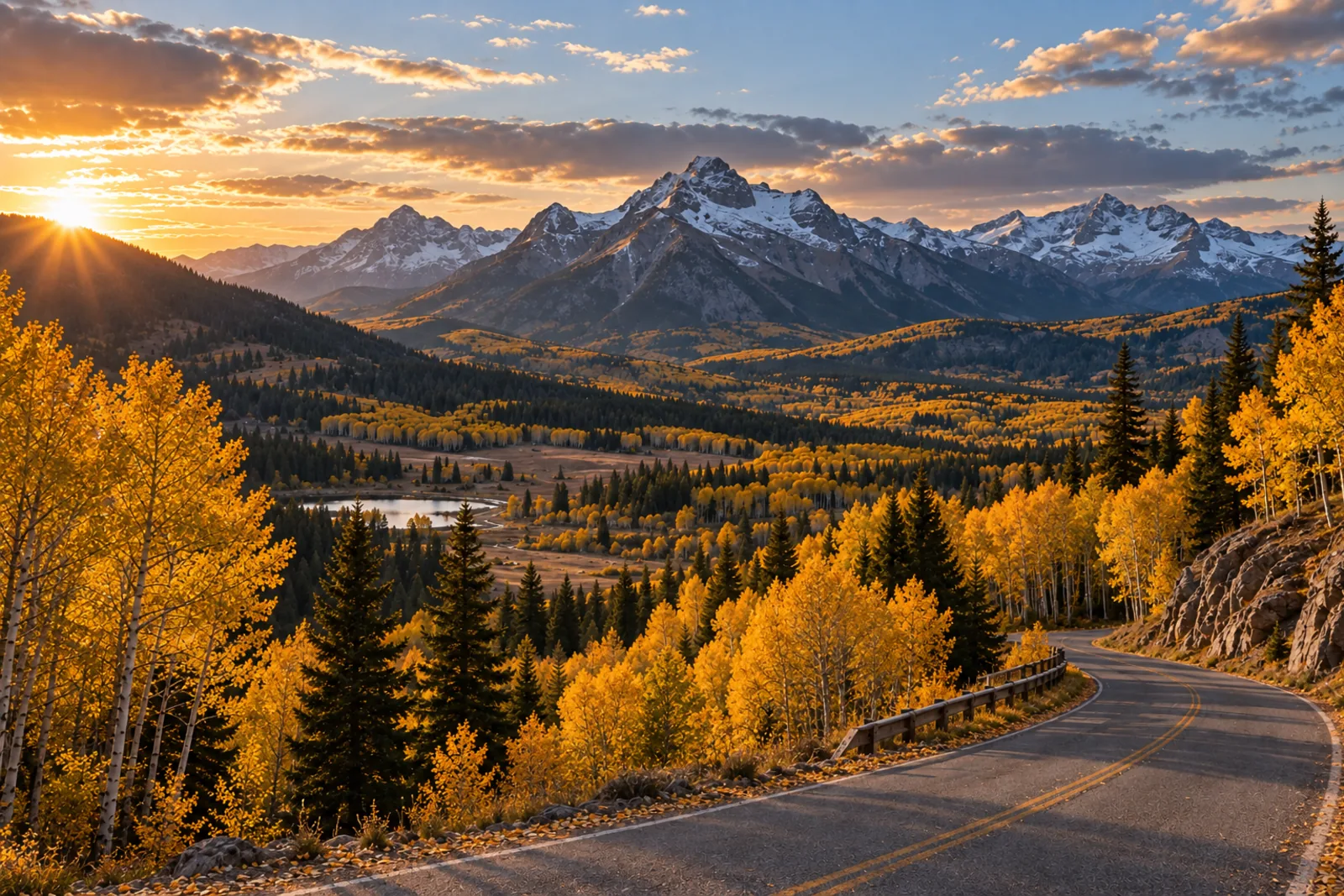
I don’t picture myself rushing between viewpoints or trying to fit ten places into one day. What draws me to it is almost the opposite: the thought of driving slowly through the mountains with nowhere particularly urgent to be, watching the road disappear around another bend while entire hillsides of aspen trees glow yellow against dark evergreens and gray-blue peaks. Somewhere farther ahead there might be a small mountain town, a diner with warm lights in the windows, or an old wooden house tucked against the slope. Somewhere behind, the road would already feel much farther away than it really was.
Autumn seems different in the mountains. It feels sharper somehow. The mornings look colder, the shadows seem longer, and even the sunlight has a thinness to it that suggests winter is waiting just beyond the ridge. In photographs of Colorado at this time of year, the yellow aspens can look almost impossibly bright, especially when the mountains behind them have already caught their first dusting of snow. There is color everywhere, but it never feels overly cheerful. Instead, there is something quiet and temporary about it, as if the landscape knows exactly how little time it has before everything changes again.
Perhaps that is part of what makes autumn so beautiful to me in the first place. The season never stays long enough to become ordinary.
And in Colorado, where the roads climb through forests, valleys and old mountain towns before disappearing into landscapes that seem to stretch forever, I imagine that feeling would be even stronger. I would want to experience it slowly — through open car windows, roadside stops, quiet walks beneath the aspens and evenings spent somewhere warm while the temperature dropped outside.
Not a checklist of Colorado.
Just a few slow days inside its autumn.
Golden Aspens and the Color of the Mountains
When I think of autumn, my mind usually goes first to deep reds, burnt orange and the brown-gold colors of fallen leaves. Colorado seems to offer something different. Its autumn is dominated by yellow — clear, glowing, almost luminous yellow — because of the aspen trees that spread across so many of its mountain slopes.
September is usually at the center of Colorado’s fall-color season, although the timing moves with elevation and weather, which means one valley can still be green while another has already turned gold. The color itself can be brief, sometimes lasting only a few weeks in a particular area, which somehow makes the whole landscape feel even more precious.
I love the thought of that uncertainty.
There would be no guarantee that every road would be at its perfect peak or that every hillside would look exactly as I had imagined it. Perhaps one morning the trees would still be holding onto green, and after a few cold nights the entire valley would suddenly seem different. Perhaps the wind would already have stripped some branches bare while another grove farther down the mountain remained completely golden.
That feels much more appealing to me than arriving somewhere with the expectation that nature will perform on schedule.
Aspens also have a particular kind of movement to them. Their leaves flutter even in relatively light wind, which is why the trees are often described as “quaking.” I imagine standing beneath them would feel very different from simply seeing their color from a distance. There would be the pale trunks rising around you, leaves shifting overhead, sunlight appearing and disappearing between them, and that constant soft movement that makes the forest seem almost alive in a different way.
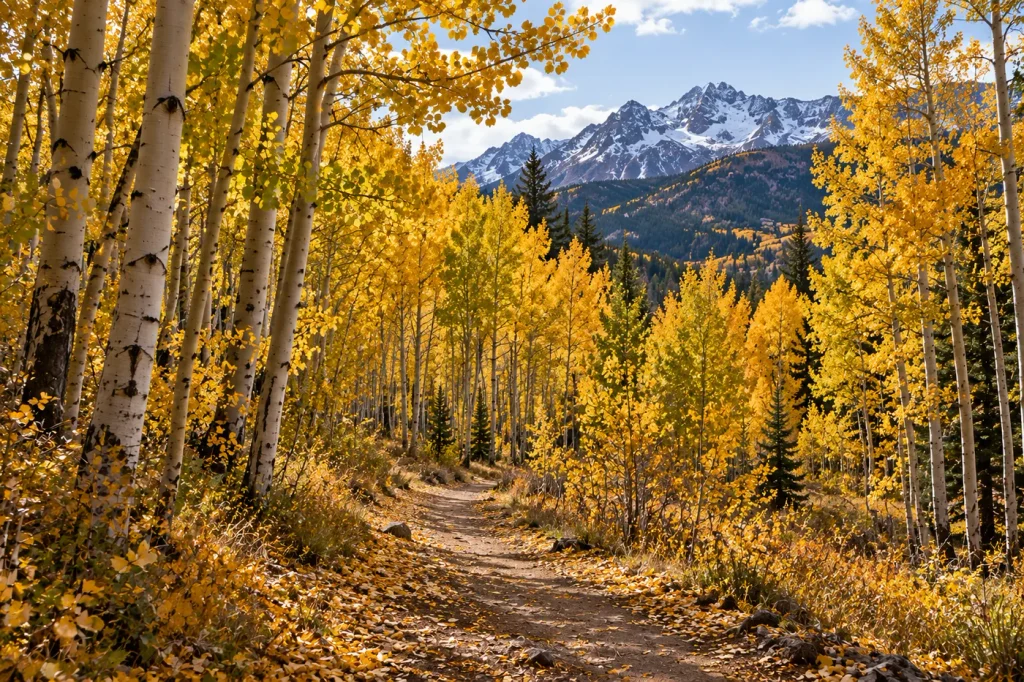
There is something about autumn landscapes that makes me want to walk rather than simply look at them. I felt the same while writing about walking through an autumn valley with the dog — the season seems to become much more real when you can hear leaves underfoot and feel the colder air rather than viewing everything through a window.
Colorado would give that feeling a completely different scale. Instead of a quiet valley enclosed by softer hills, there would be mountains rising behind the trees, stretches of evergreen breaking up the gold, and perhaps a little snow already sitting on the highest peaks.
The combination is what I find beautiful: autumn in the foreground and winter already visible in the distance.
The Roads I’d Want to Take Slowly
I think a large part of the appeal of Colorado for me is the road itself.
Not the idea of reaching somewhere quickly, but the kind of road that makes you forget about arrival altogether.
Kebler Pass near Crested Butte is one of those places I keep returning to when I look at photographs of Colorado in autumn. Much of the route is unpaved, and it runs through enormous stands of aspens, including one of the largest aspen groves in North America. In fall, the road becomes surrounded by gold, with mountain ridges appearing beyond the trees whenever the landscape opens.
It looks like exactly the kind of road I would want to drive slowly.
Windows slightly open. Heating probably on anyway because the morning would be colder than expected. Coffee somewhere in the car. No need to overtake anyone, no need to reach the next town at a particular hour.
I would probably stop far too often.
Not necessarily at the famous viewpoints either. Sometimes the places I remember most are the completely ordinary ones: a wooden fence disappearing into trees, a narrow side road that makes you wonder where it goes, an old barn standing alone in a field, or a small pull-off where the view suddenly becomes much larger than you expected.
There is something wonderfully simple about a journey when the road itself is enough.
Farther south, the San Juan Skyway makes a 236-mile loop through the San Juan Mountains, passing towns including Durango, Silverton, Telluride and Ouray. Part of the route includes the famous Million Dollar Highway between Silverton and Ouray, where the road cuts through particularly dramatic mountain terrain.
I’m not sure I would be the bravest passenger on some of those mountain roads. The Million Dollar Highway is known for steep drop-offs and sections without guardrails, so this might be one of those occasions when I would admire the scenery while quietly wondering whether we really needed to take that particular bend.
But the views would probably win.
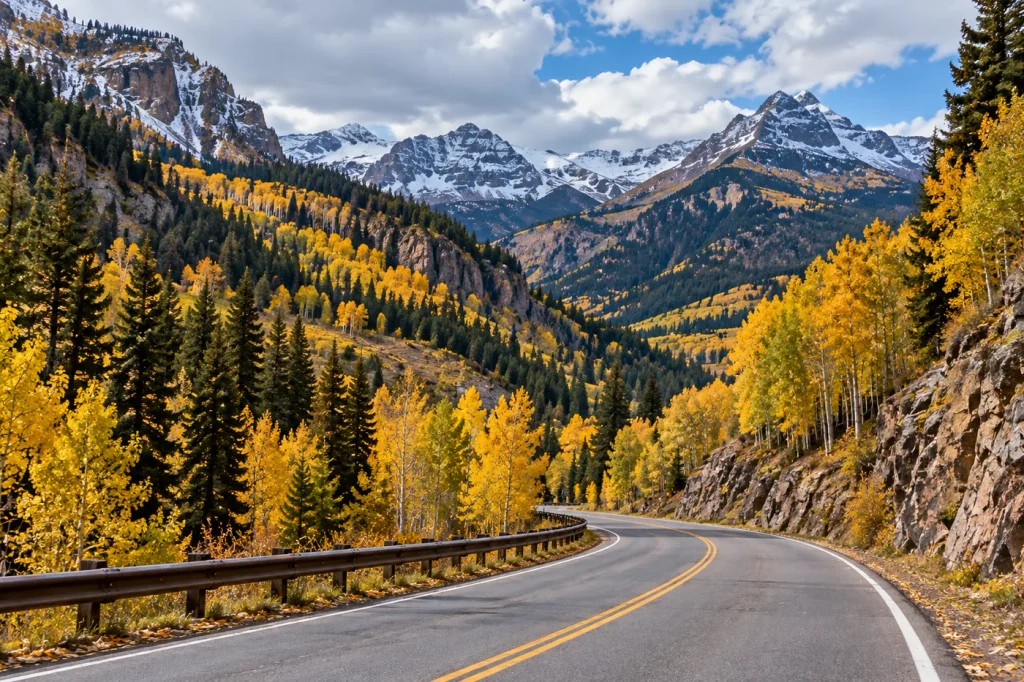
The photographs I like most aren’t necessarily the huge panoramic ones. I prefer the ones where the road remains part of the picture because they give the landscape somewhere to lead you.
A mountain on its own can be beautiful.
A road disappearing toward that mountain makes me want to know what comes next.
Mountain Towns at the End of the Road
And eventually, I would want the road to lead somewhere small.
Colorado has famous resorts and busy destinations, but the places that catch my attention most are the old mountain towns tucked into the valleys — places where the surrounding landscape still seems much larger than the town itself.
Crested Butte is one of them. In autumn, the mountains around it become covered in changing aspens, while the town itself still carries the shape and character of its nineteenth-century mining history. Nearby roads such as Kebler Pass make it an especially natural base for exploring the fall landscape.
I can imagine arriving there late in the afternoon after spending most of the day stopping along the road.
The light would already be beginning to fade behind the mountains. The air would have that cold edge that makes you pull your coat tighter even though it had felt warm in the sun an hour earlier. Somewhere there would be a restaurant filling up for dinner, people coming inside after a day outdoors, and windows beginning to glow along the street.
This is the part of travel I often like imagining most.
Not the big attraction.
The hour afterward.
When you are tired in a pleasant way, when you have stopped taking photographs, when the day has become something you can simply sit and think about.
Telluride has a different kind of setting, pressed into a dramatic box canyon beneath high peaks. Ouray is similarly enclosed by mountains, while Silverton sits high in the San Juans with its mining history still very visible in the town and surrounding landscape. Together, these communities make the southwest corner of Colorado feel like exactly the sort of place where the journey between towns could matter as much as the towns themselves.
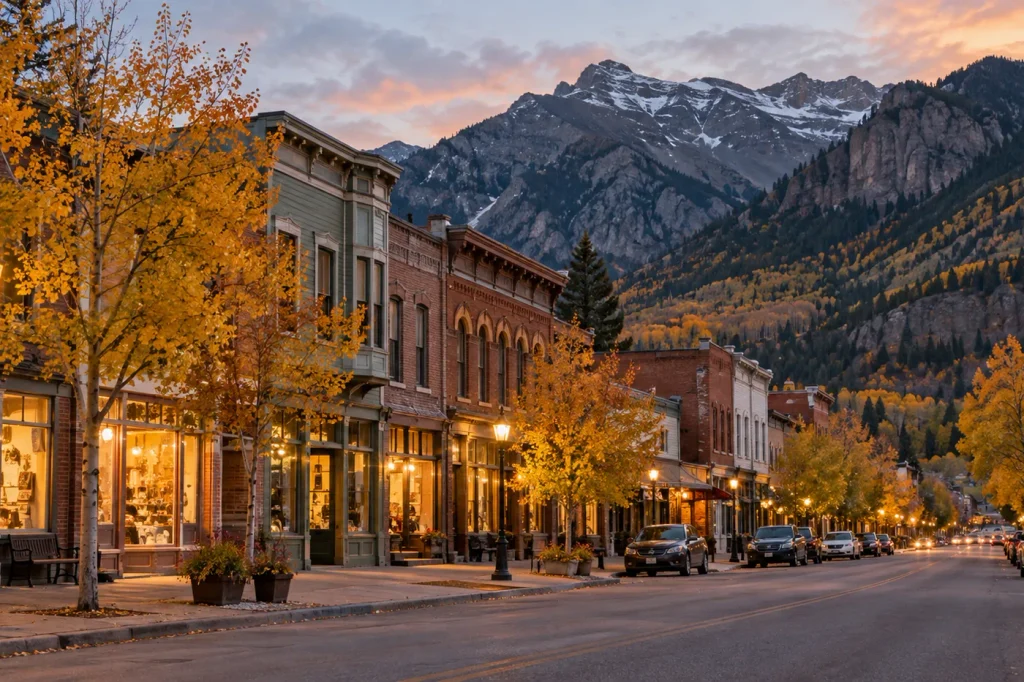
I don’t imagine needing much once I arrived.
A quiet room. Somewhere simple to eat. Perhaps a walk after dinner even though it would already be colder than I expected.
I would probably look through windows too much, noticing little houses with porch lights on and wondering what everyday life feels like somewhere surrounded by mountains like that.
That is always what happens to me with places I love.
Eventually I stop thinking like a visitor and start wondering what it would be like to belong there.
When Autumn and Winter Meet
One of the things I find most beautiful about mountain autumn is that winter often appears before fall has completely finished.
Higher elevations can receive snow while the aspens below are still golden, creating those extraordinary Colorado scenes where a hillside looks unmistakably autumnal while the peaks behind it already belong to another season. Colorado’s official tourism guidance even highlights fall hikes framed by newly snow-dusted mountain peaks.
I think I would love waking up to that.
Perhaps rain had fallen in town overnight, but the clouds would lift enough in the morning to reveal fresh snow higher on the mountains. The aspens outside would still be yellow. The road would still be scattered with fallen leaves. Nothing down in the valley would quite be winter yet.
But you would be able to see it coming.
There is a melancholy in that kind of landscape that I find difficult to explain. It is not sadness exactly. It is more the awareness that something beautiful is ending while you are still inside it.
That is why I have always loved the quiet beauty of October. The month never feels settled. It sits somewhere between abundance and emptiness, between the warmth we have just left behind and the colder season waiting ahead.
Colorado seems to make that transition visible.
Golden trees below.
Snow above.
Warm light through a cabin window while the temperature drops outside.
The last bright part of autumn standing directly in front of winter.
Perhaps this is also why I would rather see Colorado in autumn than at the height of summer.
Summer landscapes can feel permanent while you are inside them. Autumn never does.
You know it is leaving.
The Quiet Things I Would Want to Notice
If I ever made this journey, I hope I wouldn’t spend the whole time trying to find the most impressive scenery.
I would want some ordinary moments too.
Stopping somewhere early in the morning when the town was still quiet. Seeing steam rise from a cup of coffee in cold air. Watching someone sweep fallen leaves from the entrance of a shop. Hearing a dog bark somewhere across the valley. Finding a small grocery store and buying things we didn’t particularly need because somehow even grocery shopping feels interesting when you are far from home.
I would want to hear what the mountains sound like when nothing much is happening.
Perhaps there would be wind moving through the aspens. A distant truck somewhere on the road. Birds I couldn’t identify. At certain times of year, even the sound of elk can carry through Colorado’s mountain valleys, their autumn bugling becoming part of the season.
These are the details that stay with me more than the impressive ones.
I can look at a photograph of a mountain and understand that it is beautiful.
But what I want from a place is the feeling around it.
The cold railing beneath your hand when you step outside in the morning.
The smell of wet leaves beside a road.
That strange silence after a car disappears around a mountain bend.
A porch light coming on while there is still a little daylight left.
Those are the things that turn scenery into memory.
A Place That Makes Me Want to Disappear for a While
There are moments when the idea of disappearing somewhere quiet becomes particularly appealing.
Not disappearing from life entirely, of course. Just stepping outside the usual rhythm long enough to remember that the world is much larger than whatever has been taking up too much space in my mind.
Colorado seems made for that kind of escape.
The mountains alone create distance. Roads stretch between towns. Valleys open unexpectedly. A drive that looks short on a map can pass through completely different landscapes, and sometimes the next bend reveals something that makes you want to stop again.
There is freedom in that.
I imagine leaving my phone somewhere in the room for an afternoon and driving without checking it. Choosing a road because it looked beautiful rather than because an itinerary told me to take it. Stopping when we were hungry. Walking when we felt like walking. Turning back when the light started to fade.
Nothing complicated.
Perhaps that is what I am really searching for when certain landscapes stay in my imagination.
Not adventure in the dramatic sense.
Space.
Room to think.
A little distance between one day and the next.
The Colorado Autumn I Imagine
If I could choose the perfect Colorado autumn day, I don’t think it would begin with brilliant sunshine.
I would rather wake to a little mist sitting low in the valley.
The mountains would be partly hidden at first, and the road outside would still look damp from overnight rain. Somewhere nearby the aspens would already be glowing yellow even beneath the gray sky.
We would leave early without much of a plan.
Drive through the trees until the clouds began to lift.
Stop beside a quiet stretch of road simply because the view looked beautiful.
Walk somewhere beneath the aspens where the leaves had begun to cover the trail.
Then continue toward one of those mountain towns just as the afternoon light started turning warmer.
By evening, the temperature would fall quickly.
There would be dinner somewhere small and unpretentious, followed by one final walk through town before going back inside. The mountains would already be disappearing into darkness, but a few peaks might still hold the last pale light.
And then there would be nothing left to do.
That might be my favorite part.
A quiet room. Tired legs. Maybe rain beginning again against the window.
Knowing that tomorrow there would be another road.
Why I Think Colorado Would Stay With Me
I have never needed a place to be perfect for it to stay in my mind.
Usually it is the opposite.
I like weather that changes the plans a little. Roads that take longer than expected. Towns that become quiet after dark. Landscapes that feel beautiful partly because they cannot be controlled.
Colorado in autumn seems full of those things.
Its color is brief. The weather can shift. Snow may arrive in the mountains while autumn is still unfolding below. One valley may be glowing while another is already beginning to empty of leaves.
And perhaps that uncertainty is what gives the season its character.
You have to meet it where it is.
I think I would remember the golden aspens, certainly. I would remember the mountains and the roads and the little towns tucked between them.
But I suspect the thing that would stay with me longest would be something quieter.
A cold morning.
A road with no traffic.
Yellow leaves moving in the wind.
A mountain disappearing into cloud.
And the feeling, for a few days, that there was nowhere else I needed to be.