Walking Through an Autumn Valley With the Dog
There are walks I remember because of where they led, and others I remember because of the weather, the light, or something that happened along the way. Then there are the quieter walks that seem to stay with me for almost no obvious reason at all.
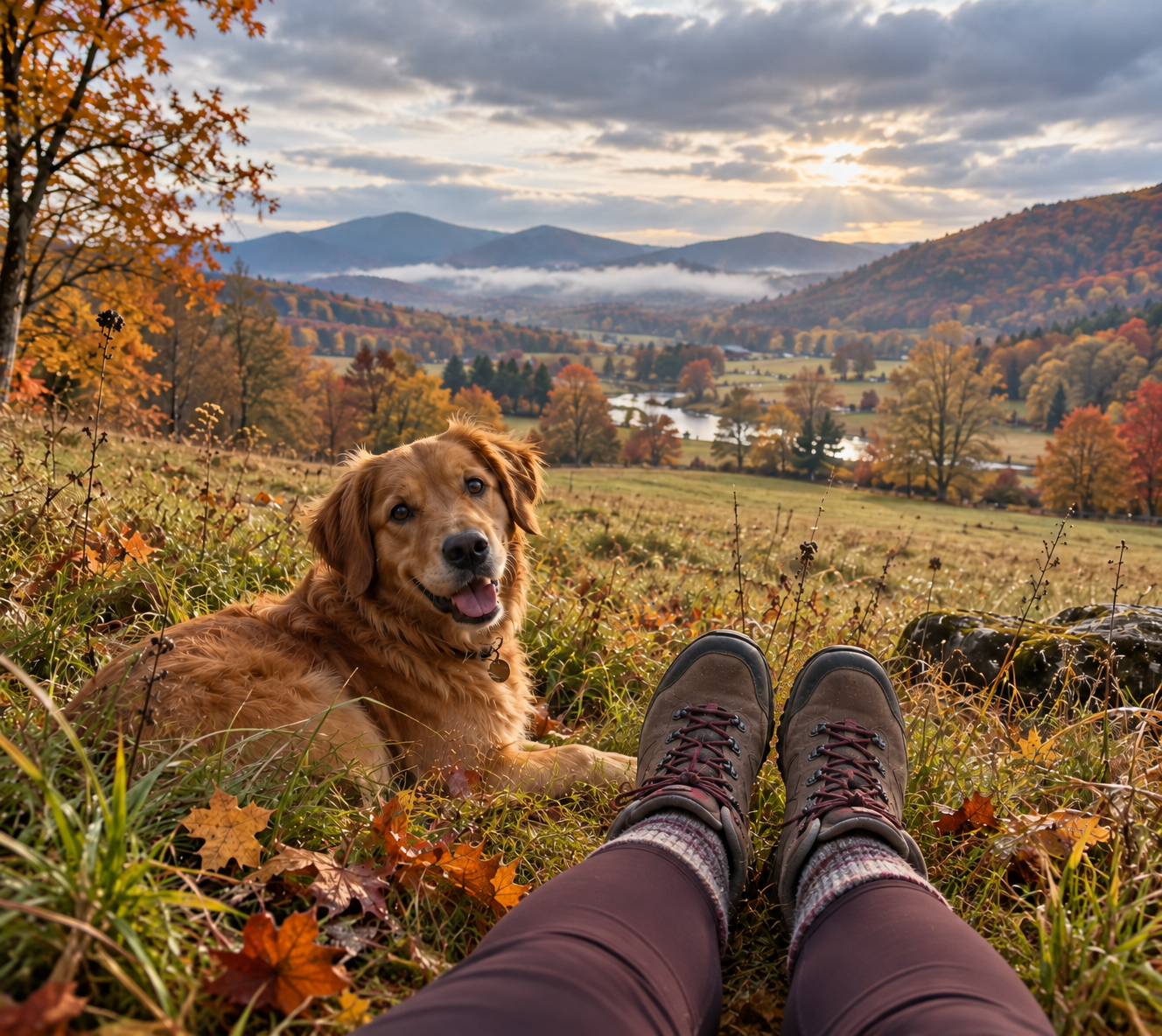
Walking through an autumn valley with the dog belongs to that last kind of morning.
There does not need to be a famous viewpoint waiting at the end. There does not need to be a café, a landmark, or a perfectly timed sunset. I do not even need the weather to be particularly beautiful. In fact, I think I prefer the sort of autumn morning when the sky remains pale and gray, the hills disappear slightly into mist, and the ground is still damp from rain during the night.
What matters is having somewhere to walk where the world feels wider than usual.
A path running between fields.
Trees beginning to thin.
A stream somewhere below.
The dog walking ahead with far more interest in every smell than I could ever have in the scenery.
And enough time that there is no reason to hurry either of us.
That combination has a way of making an ordinary morning feel much larger than it actually is.
The Best Autumn Walks Begin Without Much of a Plan
I like knowing roughly where I am going, but not every detail of the route.
There is something pleasant about setting out with the simple intention of walking for a while and allowing the landscape to decide how long the walk becomes. A path looks interesting, so we follow it. A trail bends toward the trees, and there seems no reason not to see where it goes. The dog pauses at a gate or disappears momentarily into a layer of fallen leaves, and the whole pace of the morning changes around those small interruptions.
Autumn is particularly suited to this kind of wandering because every part of the landscape feels slightly different from the last.
A stretch of woodland can still be full of yellow leaves, while the next field is already bordered by almost-bare branches. One side of the valley catches enough sun to hold its color longer, while another remains damp and shaded beneath darker trees. The path might begin firm and dry, then become muddy near the bottom where water has collected.
Nothing stays visually consistent for very long.
I like that.
It makes even a familiar route feel less predictable.
The countryside has already begun the slow transition I wrote about in the quiet beauty of October, when the brightest part of autumn starts giving way to something calmer and less polished.
A valley seems to show that transition particularly well because you can see several stages of the season at once.
Bright trees close by.
Bare branches higher on the hills.
Green fields below.
Brown leaves underfoot.
Mist lying in the lowest parts of the landscape.
Autumn does not arrive or leave all at once.
A walk like this makes that impossible to miss.
The Dog Notices a Completely Different Valley
One of the things I enjoy most about walking with a dog is knowing that we are technically taking the same walk while experiencing almost none of it in the same way.
I am looking toward the hills.
The dog is interested in a patch of grass beside the path.
I stop to look at a line of trees reflected in the water.
The dog has discovered that something extraordinarily important happened beside a fence post several hours earlier.
I notice the changing leaves.
The dog notices whatever animal crossed the trail during the night.
There is something grounding about that difference.
It stops the walk becoming too self-conscious.
I may be thinking about how beautiful the valley looks beneath a gray sky, but beside me there is a creature entirely unconcerned with whether the landscape is picturesque. Every smell, puddle, branch, and patch of mud is simply information.
The dog does not need the day to be beautiful.
It only needs the day to be interesting.
I think there is something useful in that.
It reminds me to experience the walk physically rather than only visually.
The cold air.
The damp ground.
The sound of leaves moving beneath boots.
The smell of wet bark.
The small pull of the lead when something suddenly becomes more interesting than I am.
Autumn is not just something to look at.
Walking with the dog makes sure I remember that.
The Valley Feels Quieter Than the Road Above It
There is usually a moment when the sounds of ordinary life begin disappearing.
Perhaps the path drops lower.
Perhaps the trees thicken.
Perhaps the road simply moves farther away.
Whatever the reason, traffic becomes something distant rather than immediate, and the quieter sounds of the landscape begin replacing it.
Water moving over stones.
Birds somewhere in the hedges.
Wind passing through dry leaves.
The occasional shake of the dog’s collar.
Footsteps.
Nothing particularly dramatic.
But once those sounds become noticeable, the walk seems to have properly begun.
I think this is one of the reasons valleys feel so peaceful to me. The land itself creates a sense of enclosure without making the landscape feel small. Hills rise on either side, trees follow the slopes, and the path moves through the lowest part of the scenery as though it belongs there naturally.
The world is still broad, but it feels protected.
On a gray autumn morning, that feeling becomes even stronger.
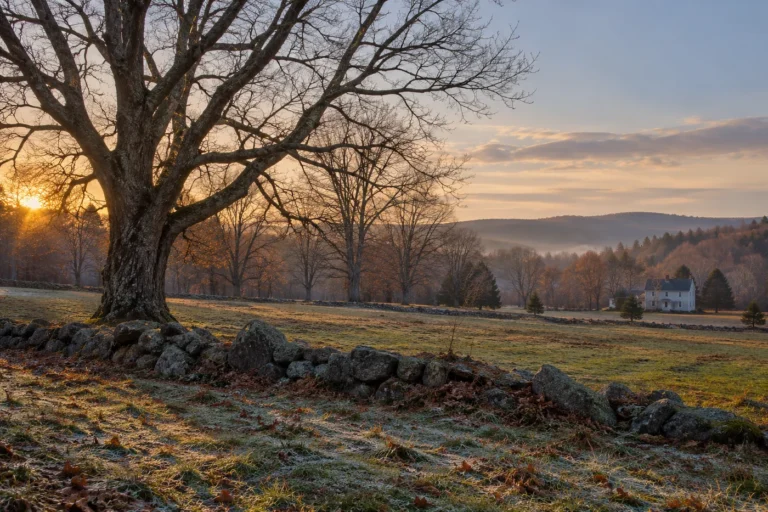
Mist can hang over the hills while the path remains clear below. Distant farms appear and disappear through it. Trees on the ridge become silhouettes rather than individual shapes.
The valley keeps some things visible and hides others.
It makes the landscape feel deeper than it did from the road.
A Stream Changes the Whole Walk
If there is water in the valley, I almost always want the path to follow it for a while.
A narrow creek is enough.
It does not need to be dramatic.
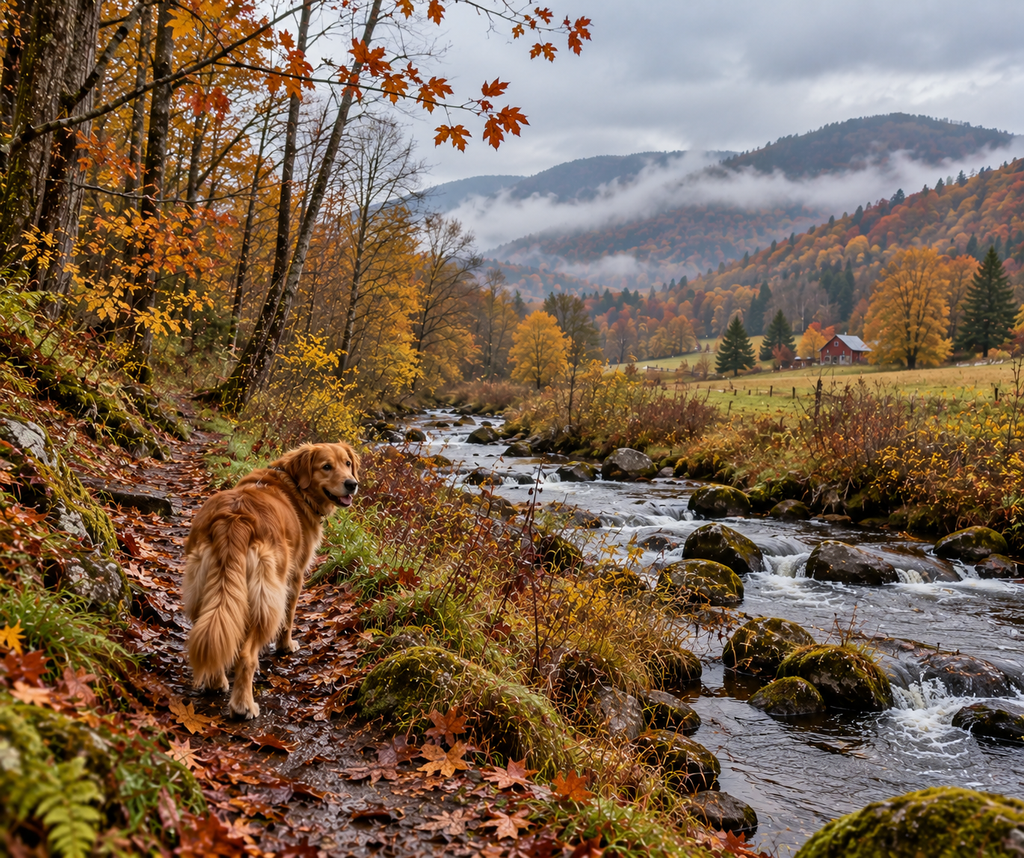
In autumn, even a small stream becomes part of the atmosphere because the trees around it seem to collect there. Leaves gather against rocks. Water turns darker beneath branches. The path becomes softer and muddier along the bank, and the sound of moving water follows the walk even when the stream disappears behind vegetation.
The dog usually finds the water more interesting than I do.
There is always a moment of deciding whether stepping closer to the bank is a good idea, followed by the realization that the decision has already been made.
Autumn water feels different from summer water.
It looks colder.
Perhaps that sounds obvious, but the whole character changes once the trees above it begin losing their leaves. The surface reflects more sky. Bare branches appear in the water. Brown leaves collect in slow-moving corners.
A stream that might have looked cheerful in June begins feeling quieter and older by late October.
I like that version.
Mud Makes the Walk Better, Within Reason
A perfect dry trail looks lovely in photographs.
A slightly muddy trail feels more like autumn.
I do not mean deep mud that turns the entire walk into an exercise in keeping shoes attached to feet. There is a limit.
But damp ground, puddles, and a few places where the path requires a little attention make the season feel more real.
Autumn is not supposed to be entirely tidy.
Leaves are decomposing.
Rain has soaked the earth.
Grass stays wet longer.
The edges of footpaths become softer.
The dog somehow manages to identify the wettest possible section of every route.
That is part of it.
I think I enjoy these walks more once I stop worrying about returning perfectly clean. A good pair of boots changes the entire experience. Instead of avoiding every muddy patch, I can simply keep walking.
That small practical freedom matters more than it sounds.
There is a difference between admiring autumn from a pavement and actually walking through it.
Mud is usually part of the second version.
I Love the Open Parts of the Valley Most
Woodland is beautiful in autumn, but there is something about stepping out of the trees into an open field or meadow that changes the whole mood of the walk.
Suddenly the sky feels much larger.
The hills become visible again.
The wind is stronger.
You can see where the path has come from and, sometimes, where it is going.
The dog usually runs or walks differently in these open spaces too, as though the landscape itself has created more energy.
I like standing somewhere in the middle of a valley and being able to see the slopes rising on both sides.
Farmhouses appear small.
Trees become groups of color rather than individual trunks.
A road in the distance looks almost insignificant.
If mist is moving through the hills, the entire scene can change within minutes.
One ridge disappears.
Then returns.
A patch of sunlight briefly reaches the field.
Then the cloud closes again.
These are the kinds of autumn scenes I want more of for The Quiet Hearth — landscapes that feel lived in rather than staged.
No basket of pumpkins needs to be placed beside the path.
No perfect blanket needs to be spread beneath a tree.
The valley already contains enough.
Sometimes the Dog Decides When We Stop
I can walk past a bench without noticing it.
The dog usually has other ideas about stopping.
Not necessarily because of the bench, of course.
There might be a tree nearby that apparently requires ten minutes of investigation.
A patch of grass may contain information too complex to process quickly.
Or perhaps we simply reach the point in the walk when slowing down feels natural.
I like those pauses.
They allow the landscape to catch up with me.
While walking, attention is always moving. I am watching the path, looking ahead, adjusting pace, checking where the dog is going. When we stop, I begin hearing more.
Water.
Wind.
A distant bird.
Perhaps a tractor far across the valley.
The sound of leaves when the dog moves through them.
There is no need to fill the pause.
That is one thing autumn countryside seems particularly good at teaching.
Silence does not always need company.
The Gray Days Can Be Better Than the Bright Ones
Bright autumn days are easy to appreciate.
Everything glows.
Leaves become almost unreal in sunlight.
The sky turns deep blue, and photographs seem to take themselves.
But I think I prefer the quieter gray days for walks like this.
Cloud softens everything.
Colors become deeper rather than brighter.
The valley looks less like a postcard and more like somewhere people actually live.
Red barns become darker.
White farmhouses stand out against the hills.
The remaining orange leaves look richer beside bare branches.
Mist stays longer.
The weather gives the whole landscape a calmness that clear skies sometimes remove.
Gray weather also makes the walk feel more private.
There are usually fewer people on the trails.
Nobody is rushing toward the perfect viewpoint.
The dog and I can simply keep going.
I felt something similar when writing about walking in the rain when the streets are quiet. Weather has a strange way of reducing the world without making it smaller.
A gray valley does the same thing.
It lowers the volume.
Old Fences Make Every Autumn Landscape Better
I am not sure why.
Perhaps it is because fences show how the land has been divided and used over time. They make fields feel connected to human life without making them feel developed.
A simple wooden fence running across a hillside can completely change the way I see the landscape.
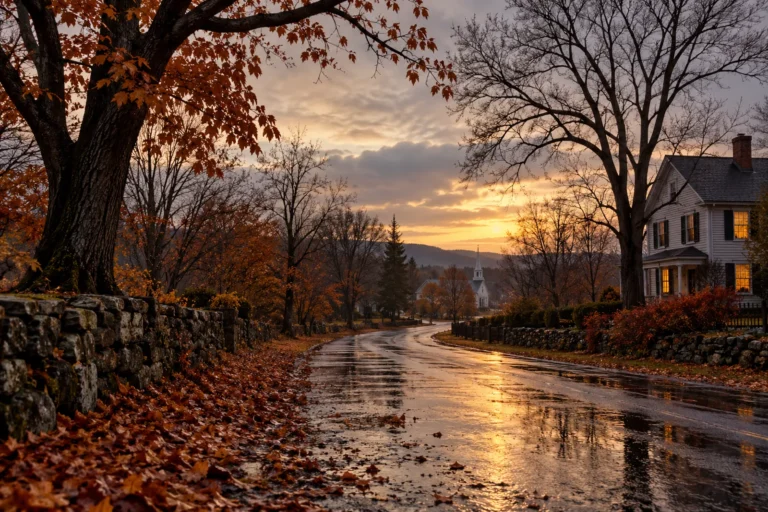
So can an old stone wall.
They give the eye something to follow.
Through autumn, they become even more interesting because leaves gather around them, moss darkens after rain, and grass grows less evenly along their edges.
The dog, naturally, finds fences interesting for entirely different reasons.
But for me, they create a sense of continuity.
Someone built that boundary.
Someone has repaired it.
Animals have moved through the field beside it.
Seasons have changed around it for years.
There is something comforting about structures that quietly remain while everything living around them changes.
I Would Rather See One Farmhouse Than Twenty Houses
I think a single farmhouse in the distance adds more to a valley than an entire neighborhood ever could.
Not because I dislike houses, but because distance changes them.
A white farmhouse beneath autumn trees.
A red barn farther across the field.
Perhaps a thin line of smoke or a light in one window as the afternoon begins getting darker.
Those small signs of human life keep the landscape from feeling empty without taking over the view.
They also make me wonder about ordinary things.
Who wakes up there?
What does the valley look like from that kitchen window?
How muddy is the road after several days of rain?
Does the dog living there know every field better than I ever could?
The questions do not need answers.
They simply make the landscape feel inhabited.
And inhabited landscapes have always interested me more than perfect wilderness.
The Dog Makes Me Walk Farther Than I Would Alone
This is probably true more often than I would like to admit.
If I were walking alone, I might turn around earlier.
The weather looks uncertain.
The path has become muddier.
The car is already far enough away.
There is no particular reason to continue.
Then I look at the dog, who appears to consider the morning barely started.
So we keep going.
And almost inevitably, the best part of the walk appears after the point where I might otherwise have turned back.
A wider view of the valley.
A footbridge.
A quieter path.
A field filled with fallen leaves.
A small bend in the creek.
Nothing enormous.
Just enough to make continuing worthwhile.
Dogs are good at removing the idea that every walk needs a purpose beyond walking.
They do not ask whether the next half mile contains anything worth seeing.
The next half mile is worth seeing because it is the next half mile.
There Is Always a Point When Home Begins Sounding Good
Eventually, even the best autumn walk reaches the moment when I start thinking about going back.
The air feels colder than it did at the beginning.
Shoes are muddier.
The dog may finally be walking at a slightly more reasonable pace.
The light has changed.
And somewhere in the distance, home begins feeling increasingly appealing.
I do not think that feeling spoils the walk.
It completes it.
Outdoor autumn comfort and indoor autumn comfort depend on each other.
A warm room means more after being outside in cold air.
Dry socks become strangely important.
Coffee tastes better.
Even an ordinary hallway feels welcoming once muddy boots are standing inside it.
That contrast is one of the reasons I love autumn so much.
The season keeps giving me reasons to go outside and reasons to come back in.
The Return Route Never Feels Exactly the Same
Even when we retrace the same path, the journey back feels different.
Partly because I am facing another direction.
Partly because the light has changed.
And partly because returning always carries a different mood from setting out.
On the way out, everything feels open.
How far will we walk?
What is around the next bend?
Will the rain hold?
On the way back, the route becomes familiar.
There is the gate again.
The muddy section.
The bridge.
The field.
The place where the dog spent far too long investigating one tree.
The landscape becomes a sequence of remembered moments rather than possibilities.
I like that.
The return journey gives structure to the walk.
It turns a random path into a small story.
Late Autumn Makes the Valley Feel Older
As more leaves fall, the valley begins revealing its structure.
Stone walls become easier to see.
Old farm buildings appear through branches.
Streams are more visible.
The shape of the hills becomes clearer.
Summer covers everything.
Late autumn removes some of that covering.
The result feels older somehow.
Not literally older, of course.
But more exposed.
More honest.
A bare tree shows every branch.
An empty field shows every slope.
A ruined fence can no longer hide beneath vegetation.
The landscape begins showing its bones.
I think this is why I enjoy autumn even after the brightest colors have disappeared.
There is still plenty to see.
The beauty simply becomes quieter.
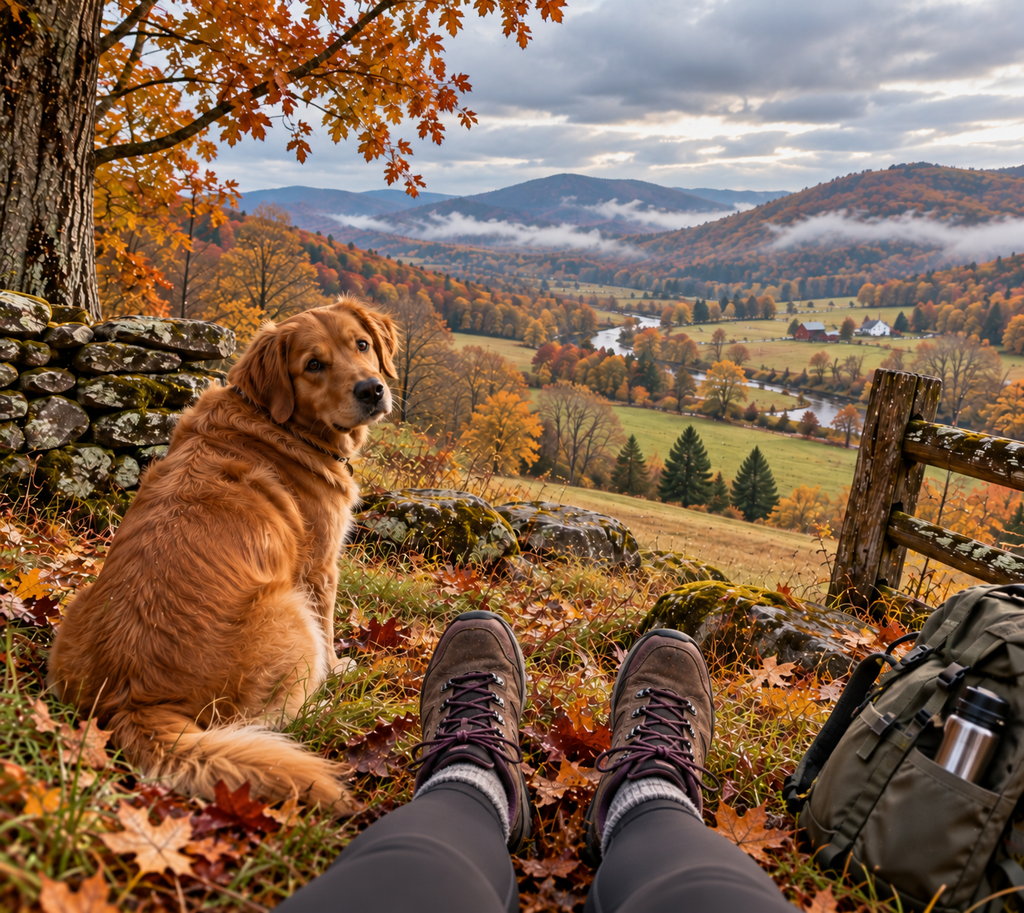
I Do Not Need the Walk to Become a Memory While I Am Living It
Sometimes there is a temptation to recognize a good moment too quickly.
This is beautiful.
I should remember this.
I should photograph this.
I should make something of this.
But the older I get, the more I think some moments are better when they are allowed to remain ordinary while they are happening.
A dog walking ahead.
A muddy trail.
A valley in autumn.
A little mist.
Nothing needs to happen.
I do not need to know whether I will remember the exact view in five years.
The walk is worthwhile even if I do not.
Perhaps especially then.
Not every good part of life needs documentation.
Some things can simply make one morning better.
Why I Love Walking Through an Autumn Valley
I think the answer is simpler than I sometimes make it.
A long walk through an autumn valley gives me enough to notice without asking anything from me.
There is movement without urgency.
Quiet without isolation.
Weather without needing it to be perfect.
Company without conversation.
The dog provides a rhythm to the walk that keeps me from disappearing completely into my own thoughts, while the landscape gives those thoughts enough space to settle.
That balance is difficult to create deliberately.
A valley seems to provide it almost automatically.
The hills create boundaries.
The path creates direction.
The dog creates purpose.
Autumn creates atmosphere.
I only have to keep walking.
A Good Autumn Walk Does Not Need a Destination
By the time we return, the walk might have lasted an hour or three.
There may be mud on everything that can reasonably carry mud.
The dog will probably require more cleaning than expected.
The photographs, if I took any, may not quite capture what the morning actually felt like.
None of that matters.
The walk did what I wanted it to do.
It created a few hours in which the day felt slower, the landscape felt larger, and there was nothing particularly urgent waiting around the next bend.
I think that is why I love walking through an autumn valley with the dog.
Not because valleys are more beautiful than every other landscape.
Not because autumn makes every walk magical.
And certainly not because dogs make walks easier.
They often do the opposite.
I love it because all of those ordinary elements come together in a way that makes me pay attention.
The damp path.
The distant hills.
The creek.
The leaves.
The dog walking a little ahead.
The cold air that tells me I will be glad to get home later.
A morning does not need much more than that.
Sometimes the best autumn walks are simply the ones where nothing happens, nobody is waiting, and the path is long enough to let the rest of the world become quiet for a while.