The Beauty of Bare Trees, Cold Mornings, and November Light
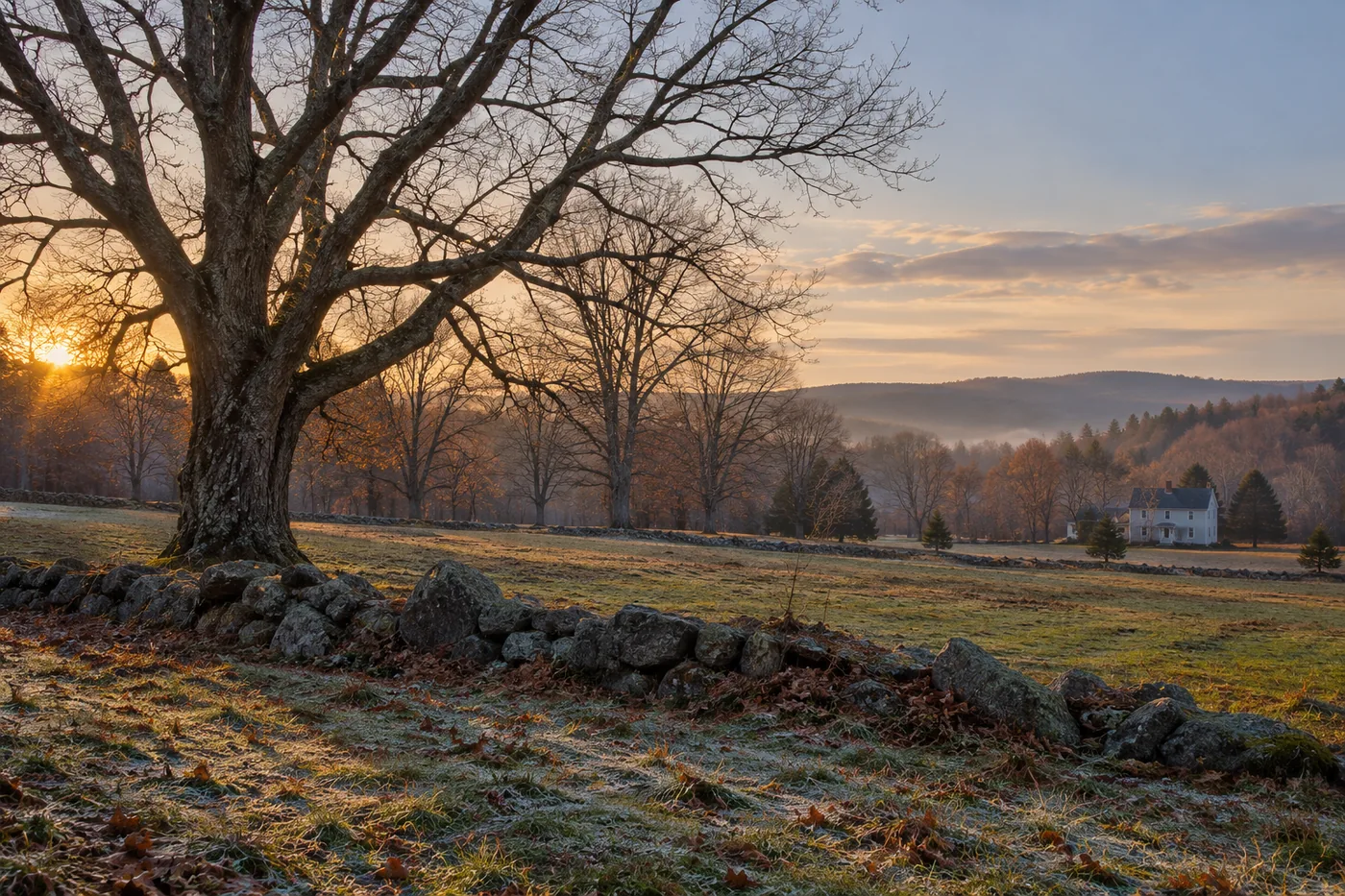
There is a particular view I like at this time of year: an ordinary house behind a tree that has almost finished losing its leaves.
A few weeks earlier, the tree would have been the first thing I noticed. Now I can see the upstairs windows, the slope of the roof, and a small stretch of sky between the branches. The house has not changed, but the view has opened around it.
November is full of small discoveries like that.
I still love the color of early fall. I would happily keep a golden afternoon a little longer if I could. But once the brightest leaves are gone, there is another version of the landscape waiting to be noticed. It has more space in it. The details are quieter, and some of them only become visible now.
When I wrote about the last days of autumn, I was thinking about how it feels to watch a favorite season fade. This time, I want to look more closely at what is still outside: the beauty of bare trees, cold mornings, and November light.
There is plenty there. You just have to stop expecting it to look like October.
What the Branches Reveal
A tree covered in leaves has a shape you can recognize from a distance. Once those leaves fall, you begin seeing how that shape was made.
A branch reaches farther over the sidewalk than you realized. Another turns sharply upward. Near the trunk, there might be a gap where something broke long ago, or a thick limb growing at an angle that gives the whole tree its character.
I like those irregularities. They make each tree easier to notice on its own.
Even a row of trees along the same street becomes more varied in November. One has a broad, open crown. Another is narrow and upright. A third leans slightly toward the road, its smallest branches drawing a fine pattern against the sky.
The view changes when you walk beneath them too. There is more sky overhead, and more daylight reaches the ground, even though the days themselves have grown shorter.
I sometimes think a bare tree deserves the sort of attention we readily give an old building. Both have a structure, a history, and small imperfections that become more interesting the longer you look.
The Landscape Opens Around Familiar Places
One of the pleasures of November is being able to see farther through places you already know.
A roof appears beyond a yard. A church steeple becomes visible at the end of a street. Through a line of trees, there is suddenly a field you have walked past without seeing properly for months.
The change can be surprisingly practical. You notice where a path leads, how close two houses stand, or the old fence running along the edge of a property. The neighborhood begins showing you its arrangement again.
Having lived in England and Scotland for several years, I have a particular affection for the landscapes there. A stone wall, an old cottage, or the dark outline of a hill feels especially at home in this season. I like thinking of those places beneath bare branches, with more of their shape visible against the sky.
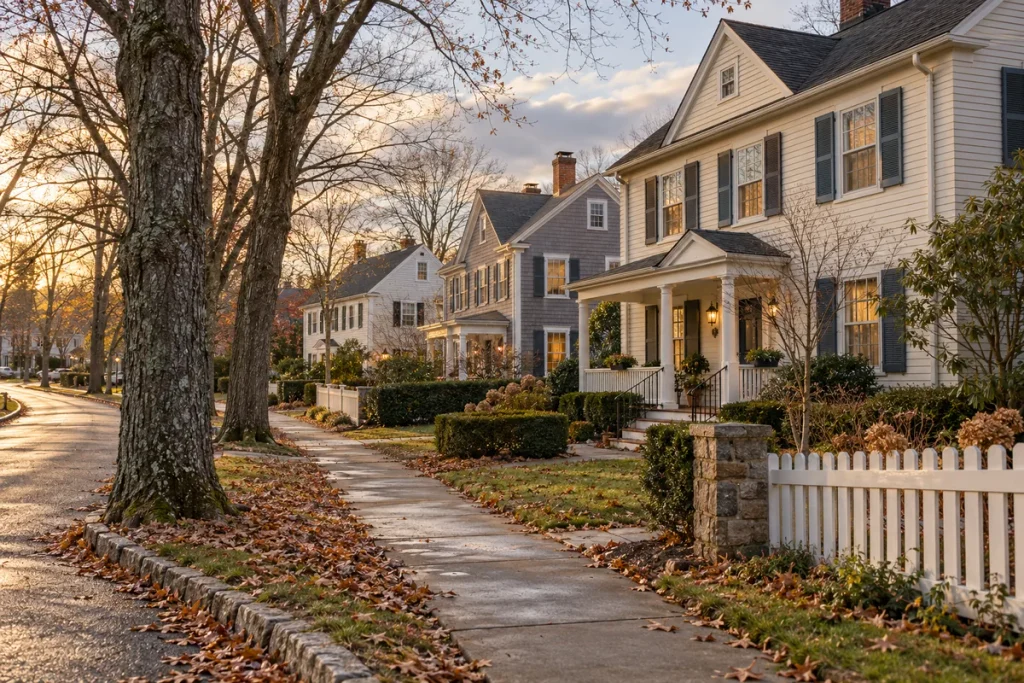
An American street offers its own version: clapboard houses, porches, mature trees, a sidewalk with leaves gathered along the curb.
Each place keeps its character. November simply gives you a little more room to see it.
The First Few Minutes of a Cold Morning
Cold mornings have a way of bringing small details into focus before the day has properly begun.
You notice the floor beneath your feet. The window feels cool when you stand close to it. Outside, the yard may still be damp, and the light has not yet reached the corners beside the fence.
On a quiet November Sunday at home, I like the idea of letting those first few minutes remain unhurried. There is time to look out while the coffee is brewing, before the phone or the day’s jobs take your attention somewhere else.
Perhaps there is frost. Perhaps there is only a pale sky and a wet lawn. I do not need every cold morning to arrive with something beautiful enough to photograph.
An ordinary morning can be worth noticing too.
A bird moves along the fence. Someone walks past in a heavier coat. The house across the street has a light on in the kitchen, although it is already morning.
Those little signs make the season feel inhabited. The landscape is quiet, but people are beginning their days inside it.
Frost Along the Edges
When frost does arrive, I tend to notice it first in the smaller places.
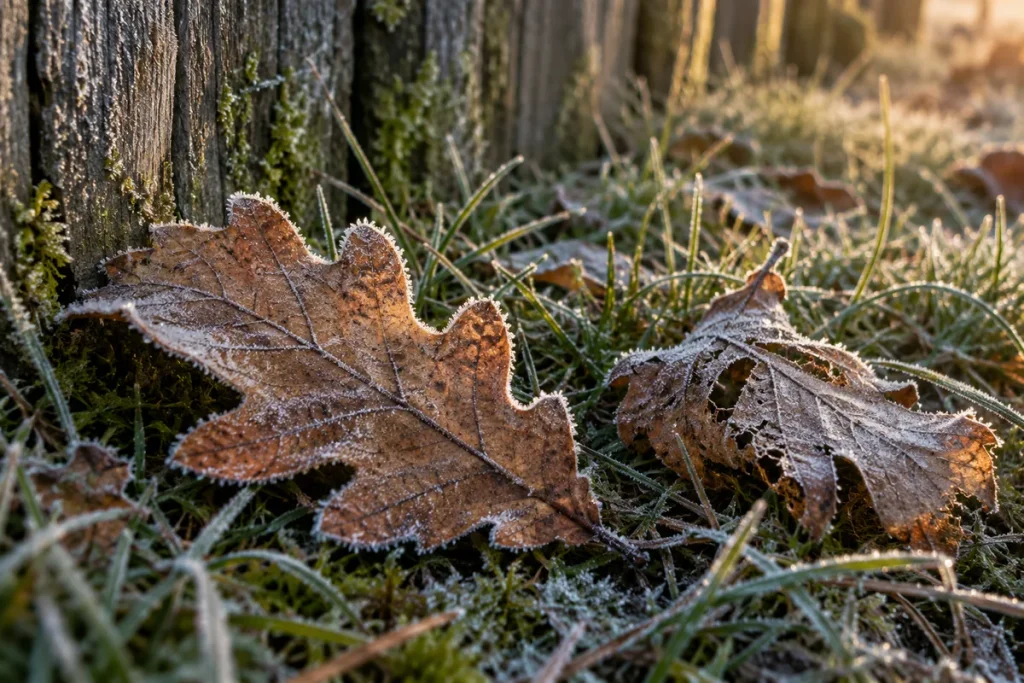
Along the edge of a fallen leaf. Across the grass where the shade has lingered. On the top of a fence or the seat of a chair that nobody has brought indoors yet.
It makes ordinary surfaces look carefully drawn.
A leaf that seemed flat and brown the day before suddenly has a pale outline. You can see its shape more clearly, and the fine veins become something worth bending down to look at.
There is a pleasure in how temporary it all is. A patch of sunlight reaches the lawn, and part of the frost begins disappearing while another corner remains untouched.
I would not want to turn every morning into an effort to catch it. Some days I will be busy, and some days I will only notice through the window.
But occasionally, it feels worth putting on a coat and stepping outside for a few minutes. The air is cold enough to make the warmth waiting indoors seem especially inviting, and the yard has quietly become somewhere different overnight.
November Light Has a Smaller Reach
The quiet beauty of October often comes with a richness that makes even a familiar road feel special. November light seems more selective.
It might reach one wall of a house while the rest of the street remains gray. A low afternoon sun catches the upper branches of a tree, then slips behind a roof before the yard beneath it has warmed.
I like how that makes you notice individual things.
A white window frame. The reddish color of old brick. A few leaves still hanging near the end of a branch. Something ordinary can hold the light for a moment and become the brightest part of the view.
Indoors, the same sunlight reaches farther across a room. A stripe falls along the floor or touches the side of a bookcase that seemed to stay in shadow during summer.
It is easy to miss if you are occupied with something else. Then you look up and find the room has acquired a small patch of warmth that was not there ten minutes earlier.
I would gladly sit with that for a while, even knowing it will not stay until evening.
Gray Days Have Their Own Colors
There are November days when no bright patch arrives at all.
The sky stays pale, the road stays damp, and everything seems to belong to the same quiet range of colors. At first glance, there may not be much to look at.
But a gray day often makes the smaller differences easier to see.
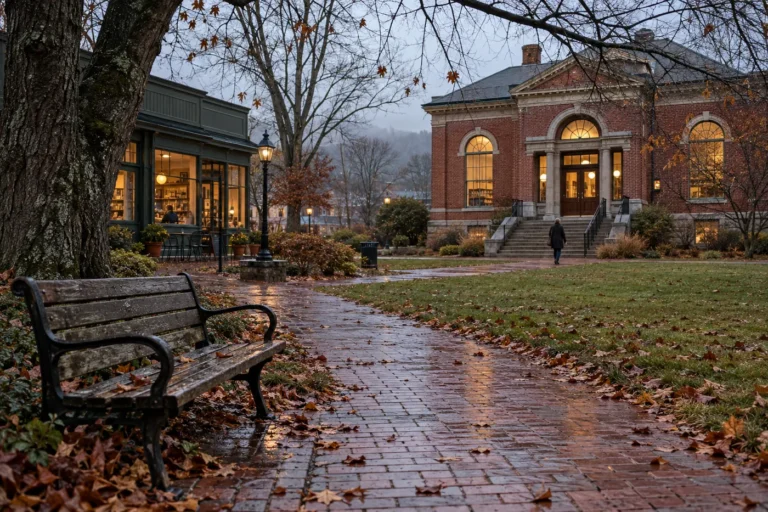
Bare branches darken after rain. A wooden fence has a warmer tone than the stone beside it. There is green in the ivy, silver in a puddle, and a deep rusty brown where wet leaves have collected beneath a hedge.
The season has not become colorless. Its colors have moved closer to the ground and settled into things we might overlook when the trees are bright.
I like that softer view from indoors, especially when the room needs a lamp before lunchtime. Through the window, the world looks subdued, but it still has texture and depth.
A cloudy sky can make the whole scene feel calm enough to study. Without sunlight asking you to look in one particular direction, your eye can move slowly from the fence to the branches to the wet path beyond them.
Old Houses Beneath Bare Trees
I always seem to come back to houses when I think about seasonal beauty.
They give the landscape a human scale. A tree might be enormous, the sky might fill the whole view, but a front step or a small kitchen window gives you something familiar to imagine.
November makes those details stand out.
On an older American house, you can see the porch posts more clearly once the tree beside them has lost its leaves. The upstairs windows seem closer to the road. A chimney rises through branches that were hidden in summer.
A modest house can be just as interesting as a grand one. Weathered siding, a narrow porch, and a light near the door are enough to give it presence.
I like imagining how the view would change during a walk. From one angle, the house is framed by branches. A few steps farther along, you can see the side yard and a window you had not noticed before.
There is no need to turn it into a mystery. Sometimes an old house in November is simply a home made more visible by the season around it, with someone inside getting ready for dinner.
A Walk Without Much to Look For
A November walk does not always offer a destination worth announcing.
You might go around the same few streets, take the ordinary route past the park, or walk only far enough to feel that you have been outside before the daylight goes.
I like the lack of pressure in that.
There is no need to find a perfect tree or arrive somewhere at the right moment. The pleasure can be in the small changes along the way: a yard you can see into again, a puddle holding the branches overhead, a late leaf moving across the sidewalk.
You notice different things when you are not looking for a scene that matches an idea you already have.
Perhaps the most beautiful part will be a plain stretch of road beneath a pale sky. Perhaps it will be the view back toward the houses when you turn around.
And perhaps you will come home without finding anything especially memorable, only feeling a little more familiar with the day.
That seems enough to me. Being outside does not have to produce a story before it has been worthwhile.
When the Windows Begin to Glow
The light inside houses becomes part of the view much earlier now.
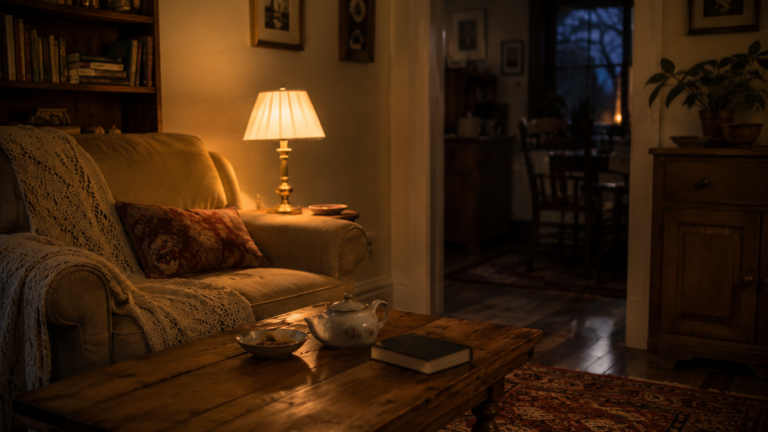
There is a brief stretch of late afternoon when you can still see the street clearly, but lamps have begun coming on behind the windows. Outside has not quite become night. Inside has already begun preparing for it.
That is one of my favorite November moments.
A warm square of light appears between the bare branches. Farther down the road, someone switches on a porch light. The windows reflect a little of the sky while allowing you to see that a room is lit behind them.
I do not need to know anything about the people there to find it comforting. The simple fact that ordinary life is continuing inside those houses gives the street a warmth of its own.
And when I reach my own door, the evening view changes again.
The cold belongs outside. A lamp goes on, and perhaps I begin thinking about classic novels for long November evenings, or a film I have seen often enough to enjoy without giving it my full attention.
The landscape has had its part of the day. Now there is the pleasure of being home within it.
Looking Without Trying to Keep It
I sometimes reach for a photograph when a view seems especially lovely, then find the picture less interesting than the moment was.
The camera has caught the branches and the house, but not quite the feeling of standing there in the cold. It cannot include the sound of someone closing a gate nearby, or the small pleasure of having stopped when I could have kept walking.
I still like taking pictures. I simply do not want taking one to become the only way of acknowledging that something was beautiful.
There is room for noticing and then continuing with the day.
A little frost beside the steps can melt without being recorded. The sunlight can leave the room. A tree can lose the last few leaves while I am busy elsewhere.
The season will offer other things tomorrow, and I do not need to collect all of them to feel that I have been paying attention.
That makes November easier to enjoy. Its beauty can remain ordinary, belonging to the view from the kitchen or the road on the way home.
What I Want to Notice This November
If I could choose one thing to carry through this part of the year, it would be the habit of looking a little longer.
At the tree whose branches are finally visible. At the frost on the shaded side of the yard. At the house that catches the afternoon sun for only a few minutes.
These things do not ask for a trip or a special plan. Many of them are waiting in places I already pass, or just beyond a window I look through every day.
There will be November mornings when I am impatient with the cold, and afternoons when I wish the light would stay. Loving a season does not mean enjoying every hour of it.
But I want to leave room for the moments that surprise me.
A clear sky behind bare branches. A pale reflection on a wet sidewalk. A familiar house with its windows glowing before the evening has properly begun.
Then I can come inside, close the door, and let the rest of the day be ordinary. The view will still be there in the morning, changed a little by the weather and the light. I would like to see what it looks like then.