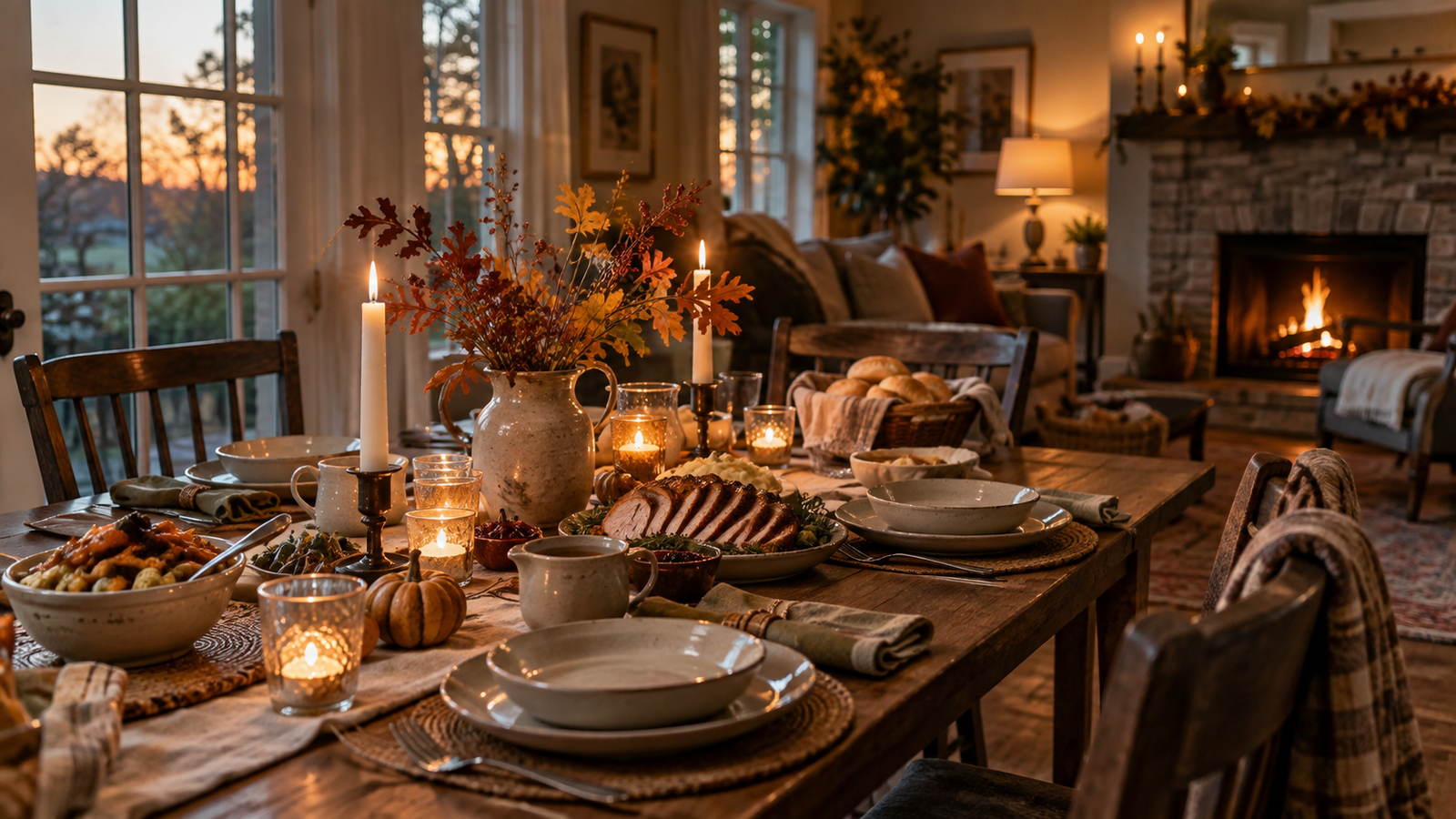
The Quiet Side of Thanksgiving: What I Want to Remember Before the Holiday Rush Begins
The quiet side of Thanksgiving is the part of the holiday I find most meaningful. It has very little to do with decorations, recipes, or trying to create the perfect holiday table.
It comes at a point in the year when everything is beginning to speed up.
Fall is almost finished. Christmas is close enough that shops, advertisements, plans, gift lists, travel, decorations, and expectations are already gathering around us. The year suddenly feels as though it is running toward its ending, and it becomes very easy to think only about what still needs to be done.
Thanksgiving feels different to me.
At its best, it asks us to look in the opposite direction.
Not toward what we still need to buy, arrange, prepare, improve, or finish, but toward what is already here.
That is the part of the holiday I find most meaningful.
Not forced gratitude. Not pretending that life is perfect because a particular date appears on the calendar. Simply stopping long enough to notice the things that can become invisible when they are part of everyday life.
Thanksgiving Feels Like the Pause Before Everything Gets Louder
I think one reason Thanksgiving appeals to me is because of where it sits in the season.
Christmas has a very strong personality.
It arrives with music, lights, traditions, films, shopping, gifts, decorations, plans, food, travel, and all the memories people carry from previous years. I love much of that, but it can also become overwhelming very quickly.
Thanksgiving feels quieter.
There is still food, family, preparation, and tradition, of course, but the central idea is much simpler: stop and appreciate what you have.
That simplicity is easy to lose.
We can turn gratitude into another performance, another list, another expectation that everyone should feel deeply thankful and peaceful at exactly the same moment.
Real life does not work that way.
Some years are difficult. Some families are complicated. Some people are tired. Some are missing someone. Some are worried about money, health, work, relationships, or what comes next.
I do not think gratitude requires ignoring any of that.
Sometimes gratitude is simply being able to say: this part is hard, but this small thing is still good.
That feels much more honest to me.
I Want to Notice the Ordinary Things Before They Change
The older I get, the more I realize that the things we think are ordinary often become the things we miss later.
A familiar voice from another room.
Someone sitting in the same chair they always sit in.
A child talking too much at the table.
A partner making coffee in the kitchen.
A dog asleep nearby.
A house that feels completely normal because we have lived inside it every day.
We rarely look at these moments and think, I should remember this.
We assume they will repeat forever.
But life changes quietly.
Children grow. People move. Families rearrange themselves. Houses are sold. Jobs change. Health changes. Traditions disappear without anyone formally deciding to end them.
That does not make me want to become sentimental about every ordinary moment.
It simply makes me want to notice a few more of them.
Thanksgiving feels like a good time to do that.
Not because everything around the table is perfect.
Because it is temporary.
Gratitude Does Not Need to Be Impressive
When people talk about gratitude, there can be a strange pressure to find something profound.
I do not think it has to work that way.
Some of the things I am most grateful for are extremely ordinary.
A warm house when the weather is cold.
Coffee in the morning.
The sound of rain when I do not need to go anywhere.
A book that makes the rest of the world disappear for a while.
A familiar meal.
Being able to call someone I love.
The feeling of coming home after a long day.
These things would not look particularly impressive written on a decorative Thanksgiving sign, but they matter because they repeat.
Big moments are memorable.
Small comforts are what make up most of life.
That is one of the ideas at the heart of The Quiet Hearth for me. Comfort is rarely one grand experience. It is usually made from ordinary things repeated often enough that they begin to feel like home.
A Full Table Is Not the Only Kind of Abundance
Thanksgiving imagery often centers on abundance.
A full table. A large turkey. Side dishes everywhere. Beautiful serving plates. Candles. Flowers. Family gathered around.
There is nothing wrong with that image.
But abundance can mean other things too.
Time.
Peace.
A safe place to sleep.
Someone who listens.
The freedom to spend an evening without being needed by everyone.
A shelf of books.
A child laughing in the next room.
Enough food without it needing to be elaborate.
A friend who still calls after years have passed.
Sometimes abundance is simply realizing that something we once wished for has quietly become part of our normal life.
We forget that easily.
The moment something becomes familiar, we stop seeing it as something we once hoped for.
Maybe Thanksgiving can be a reminder to notice that.
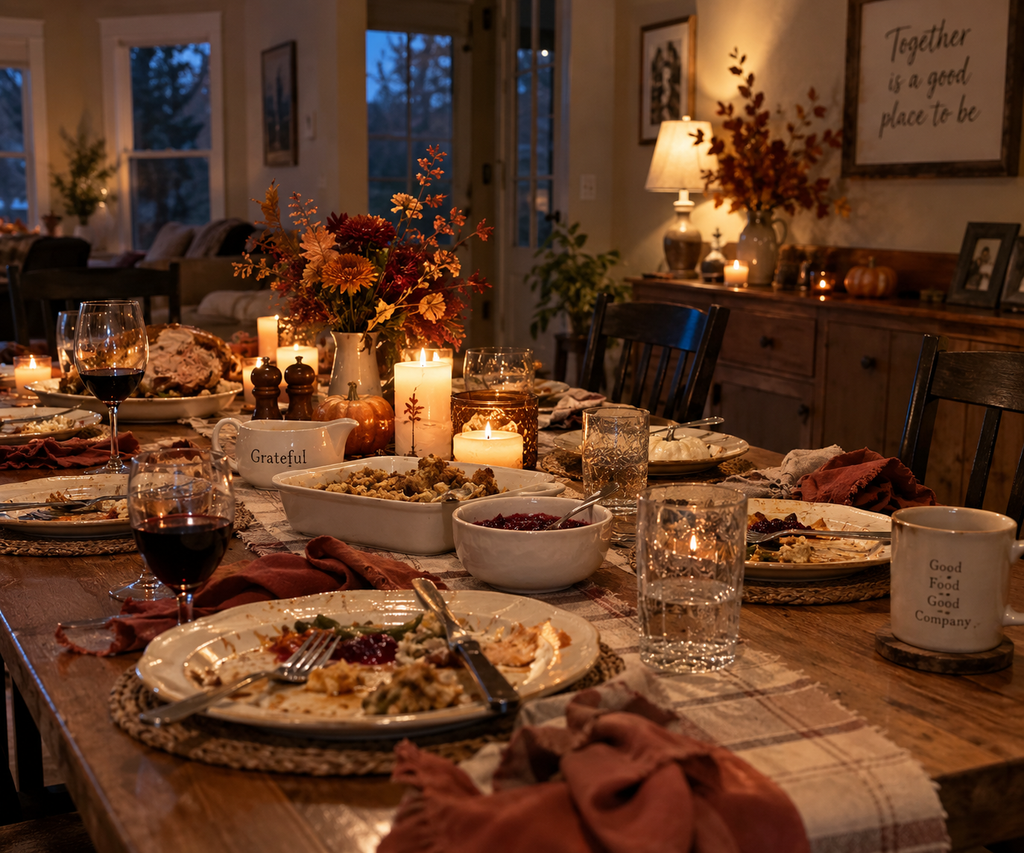
I Do Not Want Gratitude to Become Another Task
There is a version of slow living that can become surprisingly exhausting.
You are supposed to journal, reflect, light the right candle, create a ritual, practice gratitude, disconnect from technology, cook everything from scratch, decorate seasonally, and somehow be completely present while doing all of it.
At some point, relaxing starts to look like another job.
I do not want Thanksgiving to feel like that either.
I do not need to write fifty things I am grateful for.
I do not need to have a meaningful conversation on command.
I do not need the day to look like a photograph.
If I notice three or four things that I genuinely appreciate, that is enough.
Maybe the coffee tastes good.
Maybe everyone made it to the table.
Maybe the weather outside is cold and the house feels warm.
Maybe dinner turned out better than expected.
Maybe someone says something funny that everyone remembers for years.
That counts.
I think gratitude works better when it appears naturally than when we demand it from ourselves.
The House Feels Different at This Time of Year
By late November, home begins to feel different to me.
The light disappears earlier. The windows turn dark before the evening feels properly started. Warm lamps matter more. Blankets reappear. The kitchen feels more important. Food becomes heavier and warmer, and staying home starts to feel better than it did during the long days of summer.
This is also the time of year when I become much more aware of contrast.
Cold outside.
Warm inside.
Dark windows.
Lamplight.
Rain or wind beyond the walls.
Something cooking in the kitchen.
There is a particular comfort in being indoors while the season outside becomes less welcoming.
I wrote about a similar feeling in The First Truly Cold Morning of Fall, when the colder air finally makes the season feel real. By Thanksgiving, that transition is usually complete. The colder half of the year has settled in, and home becomes something we experience differently.
That atmosphere is part of why Thanksgiving belongs so naturally to this time of year.
It is not only a holiday about food.
It is a holiday centered around being inside together.
I Like the Hours After the Meal Most
The meal gets most of the attention, but I think I prefer what happens afterward.
The point when everyone stops trying to make the day happen.
Dinner is finished.
The kitchen is still a little messy.
Someone makes coffee.
People move away from the table.
The house becomes quieter.
Maybe a movie goes on. Maybe people talk. Maybe someone falls asleep on the sofa. Maybe half the family starts discussing Christmas plans even though everyone promised not to.
Those hours feel more real to me than the carefully arranged beginning of the day.
There is no longer anything to perform.
The meal happened.
The photographs were taken.
Now everyone can simply exist in the same space for a while.
I like that.
Perhaps that is why I am so drawn to old-fashioned evenings in general. There is something comforting about the point when the important part of the day is finished and nobody needs to accomplish anything else.
I Want to Remember People as They Are Now
This may be the most important part for me.
When families gather regularly, it is easy to think of everyone as permanent.
Parents stay the same age in our imagination.
Children remain children until suddenly they do not.
Traditions feel fixed until one year they change.
I think holidays make time especially visible because we repeat them.
You remember last Thanksgiving.
Then another one arrives.
And another.
The table may be similar, but the people around it are always changing.
Someone has grown older.
Someone has changed jobs.
Someone is in love.
Someone is exhausted.
Someone has had a difficult year.
Someone who used to be there may no longer be.
Someone new may have joined the family.
That is why I want to pay more attention.
Not in a sad way.
In a present way.
I want to hear the stories I have heard before.
I want to remember how people laugh.
I want to notice the small habits that seem ordinary now.
Those details eventually become the memories we wish we had paid more attention to.
Thanksgiving Is Also About What We Cannot Control
I think gratitude becomes more meaningful when life is not going exactly as planned.
It is easy to feel grateful when everything is good.
It is more interesting when things are complicated.
Most years contain both.
Something we hoped for did not happen.
Something unexpected did.
A plan changed.
A relationship became different.
Work became harder.
Money became tighter.
Someone struggled.
But perhaps something else also quietly held together.
That is often how life works.
There is rarely a year that can be labeled entirely good or entirely bad.
Thanksgiving sits near the end of the calendar and gives us an opportunity to look at the whole thing with a little more patience.
Not Was this a good year?
Maybe instead:
What carried me through it?
That question feels more useful.
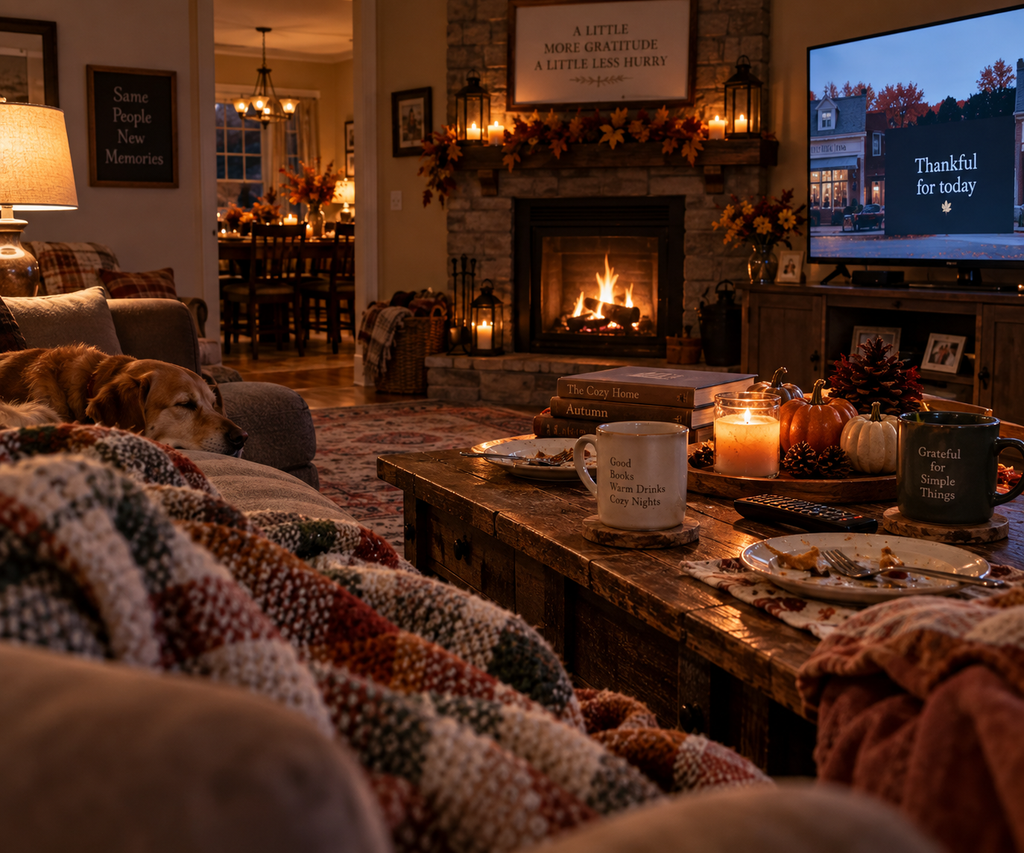
Then Christmas Can Begin
I love Christmas.
I love the lights, the films, the music, the colder evenings, the decorations, and the particular feeling that arrives when the year begins to close.
But I also like the idea of giving Thanksgiving its own space before Christmas takes over.
One quiet day before the shopping lists.
Before the gifts.
Before everything becomes red, green, gold, bright, busy, and nostalgic.
A day to sit with what already exists.
That feels especially important because Christmas naturally asks us to think about giving and receiving.
Thanksgiving can remind us what we already have.
And maybe that changes the way we enter the holiday season.
Instead of beginning from What do I still need?
We begin from What is already enough?
That is exactly the tone I want to carry into Christmas.
The Quiet Side of Thanksgiving
If I could choose one thing to keep from Thanksgiving each year, it would not be a perfect dinner or a beautifully decorated table.
It would be the pause.
That small moment before the holiday season becomes louder.
A chance to notice the people in the room.
The warmth of the house.
The food we are able to share.
The ordinary routines that have carried us through another year.
The things we complain about but would miss immediately if they disappeared.
There will always be something else to do.
Another gift to buy.
Another room to decorate.
Another plan to make.
Another year waiting to begin.
But for one day, I like the idea of letting what is already here be enough.
Not perfect.
Not permanent.
Just here.
And worth noticing.
What is one ordinary thing in your life that you want to notice more before the holiday season gets busy?