7 Gothic Books for Halloween Nights
There are books I enjoy at any time of year, and then there are books that seem to wait patiently for October.
I could open them in spring or read them during a bright summer afternoon, and the stories themselves would not change, but I suspect I would. Gothic fiction depends so much on atmosphere that the world beyond the page becomes part of the reading experience. An old house feels more convincing when the windows beside me have already gone dark. A distant footstep in a novel becomes slightly less comfortable when the rest of the house is quiet, and a road disappearing through fog feels more immediate when the weather outside has begun doing something similar.
That is why I think certain Gothic books for Halloween nights feel almost impossible to replace with anything else once October arrives..
I am not necessarily looking for the most frightening stories I can find. In fact, the books that stay with me longest are usually the ones that leave more space for unease than shock. I want old houses, family secrets, lonely roads, rooms that seem to remember things, characters who are never entirely sure what they have seen, and landscapes that make ordinary life feel slightly farther away.
The best Gothic books seem to understand that fear rarely needs to shout. Sometimes all it needs is a staircase in a quiet house, a locked room, a figure seen through a window, or the feeling that something happened long before the story began and has never properly gone away.
These are seven books I would happily keep close during the darker evenings of October.
1. The Haunting of Hill House — Shirley Jackson
If I had to choose one book that captures exactly what I want from Gothic reading in October, The Haunting of Hill House would be very difficult to beat.
Hill House is frightening long before anything obviously supernatural needs to happen. The building itself feels wrong in subtle ways, and Shirley Jackson understands that a house does not have to contain something visibly monstrous to become deeply unsettling. Rooms connect strangely, angles feel slightly off, doors refuse to behave as they should, and the people staying there gradually become more aware that the house seems to have a personality of its own.
What makes the novel especially effective for me is Eleanor.
She arrives at Hill House carrying years of loneliness, frustration, and the sense that her life has never quite belonged to her. The house therefore becomes more than a haunted setting. It offers something that ordinary life has failed to give her, and that makes her relationship with it much more complicated than a simple story about someone trying to escape a frightening place.
I think this is where Jackson is especially good. She allows psychological uncertainty and supernatural possibility to occupy the same space without rushing to separate them. You can spend much of the novel wondering where Eleanor ends and Hill House begins, and the uncertainty makes the atmosphere stronger rather than weaker.
It is also exactly the kind of book I want once October evenings become properly dark. I want the lamp on, the curtains closed, and the rest of the house quiet enough that every small sound suddenly becomes noticeable.
The novel never needs to overwhelm the reader with horror because Hill House itself is enough.
Once you enter it, the difficult part is deciding whether it ever really lets you leave.
2. Carmilla — Sheridan Le Fanu
Long before Dracula became the vampire most people immediately recognize, Sheridan Le Fanu created Carmilla.
The novella has a dreamy, enclosed atmosphere that feels almost perfect for late October. Much of the story takes place in an isolated castle surrounded by forest, where Laura lives a quiet life before the mysterious Carmilla enters it. From the beginning, there is something both intimate and unsettling about their relationship, and the story moves with the strange calm of a dream that gradually becomes more disturbing.
What I like about Carmilla is how little urgency it initially seems to have. The danger does not immediately announce itself. It enters the household politely, becomes familiar, and settles into everyday life before the characters fully understand what has happened.
That gradual approach makes the story feel surprisingly modern in places.
Carmilla herself is not simply a creature appearing in darkness. She is charming, affectionate, secretive, possessive, and difficult to understand completely. Laura is drawn toward her even while becoming increasingly uneasy, which gives the story a psychological tension that is more interesting than a straightforward monster narrative.
The setting helps enormously. Old rooms, dense woods, dreams, illness, moonlight, and the isolation of the household all create the kind of Gothic atmosphere that becomes more effective when you are reading after dark.
It is also short enough to read over one or two evenings, which makes it especially good for October. You can enter that strange, enclosed world without committing to a long novel, yet the atmosphere stays around much longer than the page count suggests.
3. The House of the Seven Gables — Nathaniel Hawthorne
There is something about an old New England house that seems almost designed for Gothic fiction.
Nathaniel Hawthorne understood that perfectly.
The House of the Seven Gables is built around a house that carries the weight of generations. The Pyncheon family history, old grudges, inherited guilt, money, pride, and the suspicion of a curse have accumulated inside the place until the building seems inseparable from everything that has happened there.
That idea fascinates me.
Houses outlive people, and because of that they become witnesses to stories nobody living can fully remember. Families change, rooms are altered, furniture disappears, but the structure remains. Gothic fiction often takes that ordinary truth and asks what might happen if the past refuses to remain quiet.
Hawthorne’s house feels heavy with that possibility.
I especially like this book for our current Halloween run because it also fits the American visual world we have been building around these articles. New England streets, old timber houses, mature trees, autumn weather, family history, and the sense that a seemingly ordinary town might contain stories much older than the people walking through it now all feel naturally connected to October.
The novel moves more slowly than a modern thriller, and I would not recommend approaching it expecting constant suspense. Its pleasure comes from atmosphere, character, history, and the gradual sense that the present has been shaped by things that happened long before it.
That slower rhythm is exactly why I would choose it for a quiet Halloween evening rather than a busy afternoon.
4. The Silent Companions — Laura Purcell
If there is one book on this list that made an ordinary object increasingly uncomfortable the longer I read, it is The Silent Companions.
The story centers on Elsie, a newly widowed woman who arrives at her late husband’s country estate and discovers strange wooden figures inside the house. These painted figures, known as silent companions, are unsettling almost immediately, but what makes them effective is the uncertainty surrounding them.
Were they moved?
Were they always standing there?
Did someone see something change, or are grief and isolation beginning to distort what seems real?
That kind of uncertainty is exactly what I want from a Gothic novel.
The house itself is isolated and deeply connected to its history, and the novel gradually moves between different periods as older events begin explaining why the present feels so wrong. The past never seems safely contained. Instead, it presses against the current story until the boundaries between memory, history, and haunting become increasingly uncomfortable.
I also think wooden figures are particularly effective because they occupy that strange territory between harmless and disturbing. A painting or statue is not frightening simply because it exists, but once you begin wondering whether its expression has changed or whether it has moved slightly from where you remember leaving it, the imagination becomes very cooperative.
This is one I would save for later in the evening.
Not because it depends on constant shocks, but because it understands how quickly an ordinary room can become unpleasant once you start questioning what is inside it.
5. The Little Stranger — Sarah Waters
Some Gothic novels immediately tell you that you are entering a strange world.
The Little Stranger does almost the opposite.
The world begins recognizably enough. Hundreds Hall is an old English country house after the Second World War, and the Ayres family who live there are struggling to maintain a way of life that is disappearing around them. The building is deteriorating, money is increasingly difficult, and the family’s relationship with the house is becoming as complicated as their relationships with one another.
Then small things begin happening.
Marks appear.
Sounds are heard.
Objects behave strangely.
Nothing arrives with a dramatic announcement, and that restraint is what makes the novel so effective.
The house feels less like a traditional haunted mansion and more like something slowly decaying around the people who cannot quite let it go. That makes the story as much about class, memory, loss, and social change as it is about whatever may or may not be haunting Hundreds Hall.
I particularly enjoy Gothic novels where the supernatural cannot be separated easily from the emotional condition of the characters, and this is one of the strongest examples of that.
By the time the strange events become impossible to ignore, the house already feels oppressive for completely ordinary reasons.
It is large, expensive, damaged, full of memories, and connected to a version of life that is disappearing.
Whether the true danger comes from something supernatural or from the people living inside that history is part of what makes the book linger after it ends.
6. Mexican Gothic — Silvia Moreno-Garcia
Mexican Gothic gives us one of the most memorable houses on this list.
High Place is remote, decaying, and immediately uncomfortable, but it is not simply the architecture that makes the setting effective. The house feels almost sealed off from the world around it, occupied by a family whose rules, history, and behavior become more disturbing the longer Noemí stays with them.
Noemí herself is one of the reasons I enjoy the novel so much. She enters the story with confidence, style, intelligence, and a life beyond the walls of High Place, which creates a strong contrast with the increasingly oppressive environment she finds herself inside.
The novel also uses some of the classic ingredients of Gothic fiction — an isolated mansion, illness, family secrets, disturbing dreams, inheritance, control, and the feeling that the house itself may contain something wrong — while giving them a setting and cultural context that makes the story feel distinct from the older European novels that established the genre.
I would not call this the quietest book on the list. As the story develops, it becomes more overtly disturbing than some of the others.
But the early atmosphere is wonderfully effective.
There is something wrong with the house.
There is something wrong with the family.
There is clearly a history everyone else understands better than Noemí does.
That gradual realization is one of my favorite Gothic pleasures: arriving somewhere beautiful or impressive and slowly understanding that you should probably have left much earlier.
7. The Monk — Matthew Lewis
The Monk is the oldest novel on this list and also probably the wildest.
Published at the end of the eighteenth century, it contains many of the things people now associate with early Gothic fiction: monasteries, hidden passages, temptation, supernatural forces, violence, secrets, ruined morality, and a willingness to push the story much further than you initially expect.
It is not subtle in the same way as Shirley Jackson.
That is part of its charm.
Reading The Monk now is interesting because you can see how many of the ingredients that later became familiar Gothic conventions were already being used with remarkable enthusiasm. The novel seems determined to explore every dark corridor it encounters, and there is something almost theatrical about the experience.
For a modern reader, some parts feel melodramatic and others genuinely disturbing, but I think that combination makes it especially interesting as an October read.
It reminds me that Gothic fiction has never been only one thing.
Sometimes it is quiet psychological uncertainty.
Sometimes it is a lonely house.
Sometimes it is family history refusing to stay buried.
And sometimes it is an eighteenth-century novel deciding that moderation is completely unnecessary.
That variety is one of the reasons I keep returning to the genre.
Gothic Books Work Because Houses Remember
Looking back at this list, I realize how many of these stories revolve around houses.
Hill House.
High Place.
Hundreds Hall.
The House of the Seven Gables.
The country estate in The Silent Companions.
Even when the story is not literally about a haunted building, Gothic fiction seems drawn toward places that carry too much history.
I think that is because houses are such useful containers for the past.
A room can remain after the person who lived there is gone. A staircase can be climbed by several generations. A family secret can remain tied to one address long after everyone involved has died.
Gothic fiction simply asks what happens when those traces of the past refuse to behave like traces.
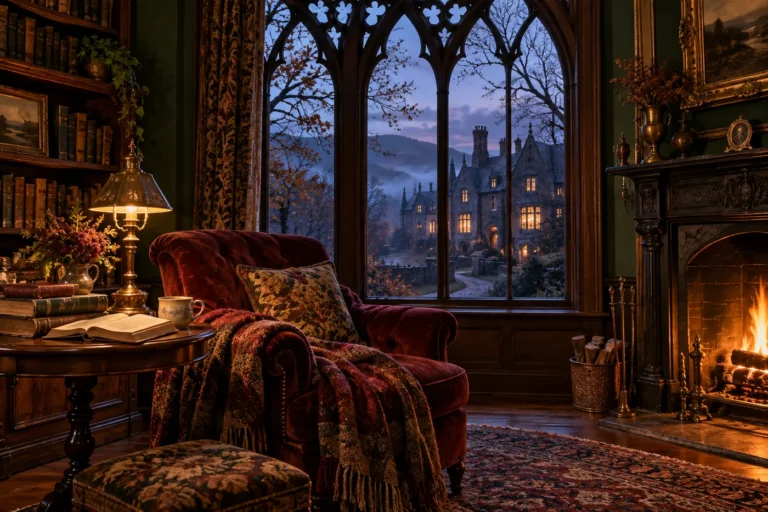
That is one reason the quiet side of Halloween appeals to me so much more than the loudest version of the holiday. An old house beneath autumn trees, one glowing window, and a little uncertainty can create far more atmosphere than something designed specifically to frighten.
Halloween and Gothic fiction seem to share the same understanding: sometimes the things we imagine are more effective than the things we are shown.
I Want Atmosphere More Than Horror
There is an important difference, at least for me, between wanting to read something dark and wanting to be frightened.
I rarely choose books because I want the most extreme horror possible. I am much more interested in atmosphere, uncertainty, isolation, old histories, and characters gradually realizing that the world around them does not work quite the way they believed it did.
That is why many Gothic books feel oddly comforting despite containing disturbing things.
The reader remains somewhere safe while the story opens a door into somewhere much less certain.
A lamp can be glowing beside you.
The house around you can be familiar.
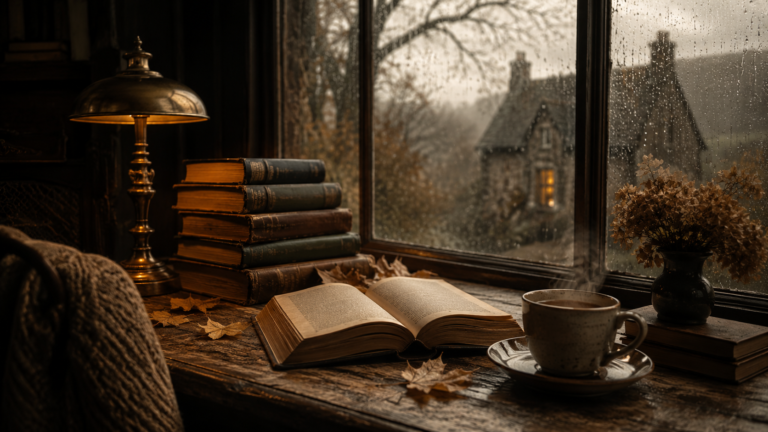
Outside, October rain can move against the windows while you follow someone into a building they should clearly never have entered.
The contrast is part of the pleasure.
It is similar to why dark and melancholy classics for cold, gray days work so well for me once the weather changes. Sometimes I do not want a cheerful story fighting against the mood outside; I want the book and the evening to agree with each other.
October gives Gothic fiction exactly the kind of surroundings it deserves.
The Best Halloween Reading Night Does Not Need Much
My ideal Halloween reading evening would probably be very simple.
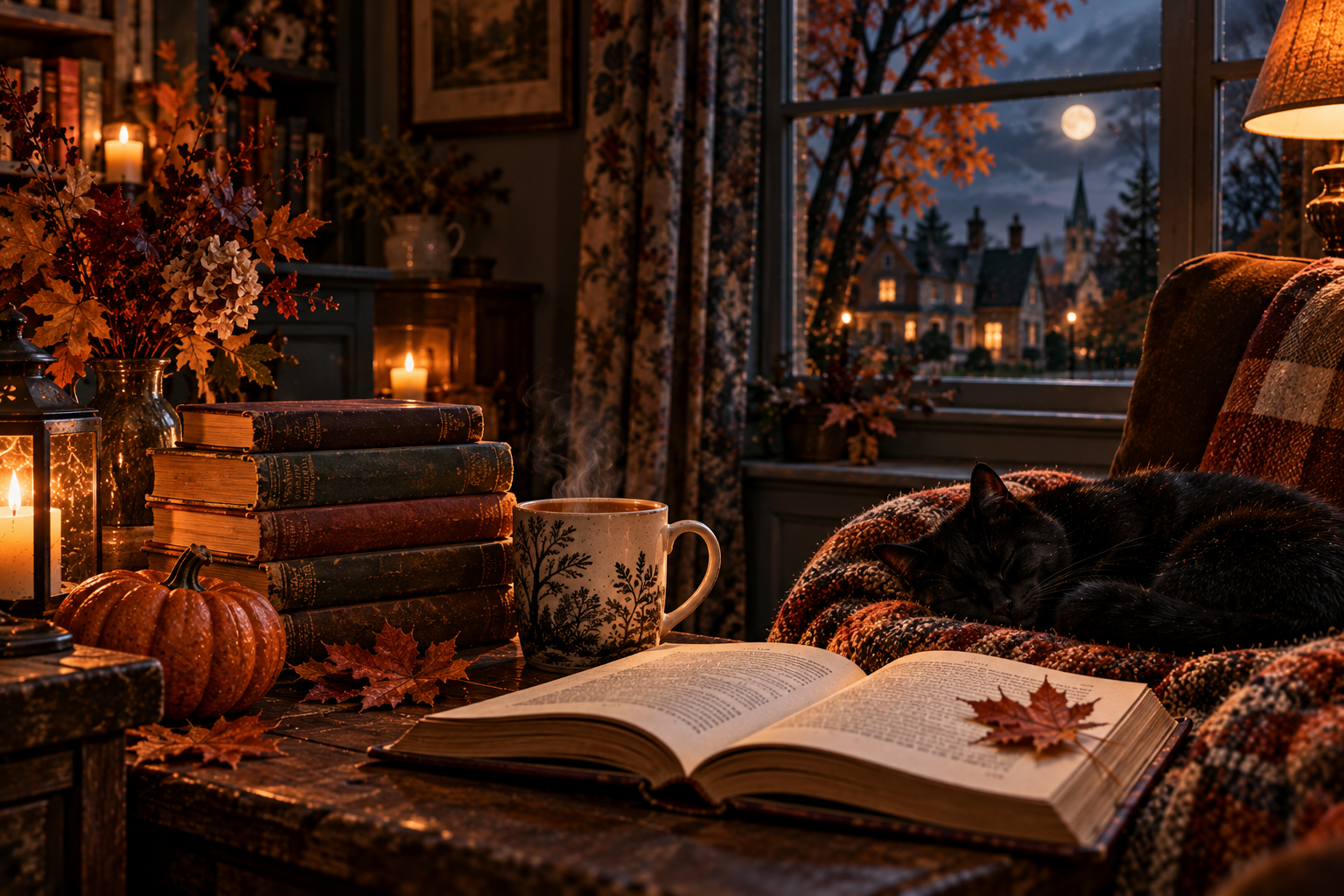
The house would already be quiet, the main lights would be off, and only a lamp or two would remain on. Outside, I would prefer rain or wind, although a completely still night can sometimes be even better because every small sound becomes easier to notice.
There would be something warm to drink nearby, but I would not want the scene to become overly arranged. The whole point is to actually read rather than create an elaborate version of reading.
I would choose one of these books, settle somewhere comfortable, and let the room gradually disappear.
That is what a good Gothic novel does particularly well. It removes the familiar world without needing to replace it with something completely fantastical. The houses still have doors and windows. The roads still lead somewhere. Families still argue, people still fall in love, money still matters, and ordinary life continues.
There is simply something else underneath it.
Something older.
Something unresolved.
Something that may have been waiting long before the first page.
Seven Different Ways Into the Dark
If I were choosing from these seven books purely by mood, I would start with The Haunting of Hill House when I wanted quiet psychological unease and a house that becomes impossible to forget. Carmilla would be for a shorter, dreamier evening, while The House of the Seven Gables would suit a slower night when I wanted history, inheritance, and the weight of an old American home.
I would choose The Silent Companions when I wanted something genuinely creepy, and The Little Stranger when I wanted a haunting that remained difficult to separate from memory, class, and decay. Mexican Gothic would be the choice for a more vivid and increasingly disturbing descent into an isolated house, while The Monk would be there for the night when I wanted to go all the way back to the extravagant roots of Gothic fiction.
They are very different books, which is exactly why I like seeing them together.
Gothic fiction does not require one particular century, one country, or one kind of ghost. What connects these stories is the feeling that the past is never quite finished, that houses can hold more than furniture, and that there are places where ordinary explanations begin becoming less convincing the longer you remain.
That feeling belongs to October.
And if the wind happens to move through the trees while I am reading, so much the better.
Which Gothic book would you choose for a dark Halloween night?