4 Classic Books I’d Read Over Thanksgiving Weekend
There is something about Thanksgiving weekend that seems made for reading.
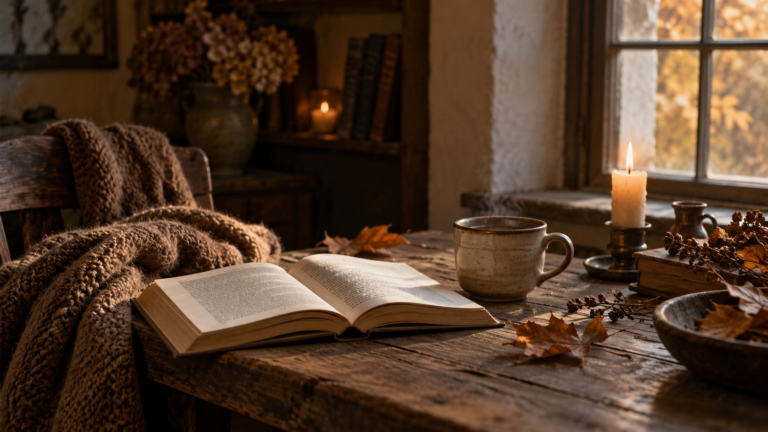
The main meal is over, the kitchen has finally begun to quiet down, and autumn itself feels as though it is reaching the very end of its season. Outside, the trees are almost bare and the light disappears earlier each afternoon. Inside, there are leftovers in the fridge, perhaps a fire or a lamp switched on before dinner, and—if everything has gone well—very little that urgently needs doing.
It feels like one of those rare weekends when staying home is not something that needs explaining.
And for me, that is exactly when a classic novel feels right.
Not necessarily something dramatic or demanding, but a book with enough atmosphere to make an already quiet afternoon feel even slower. Something about family, home, old houses, changing seasons, or simply a world where people still have time to sit in a room and talk.
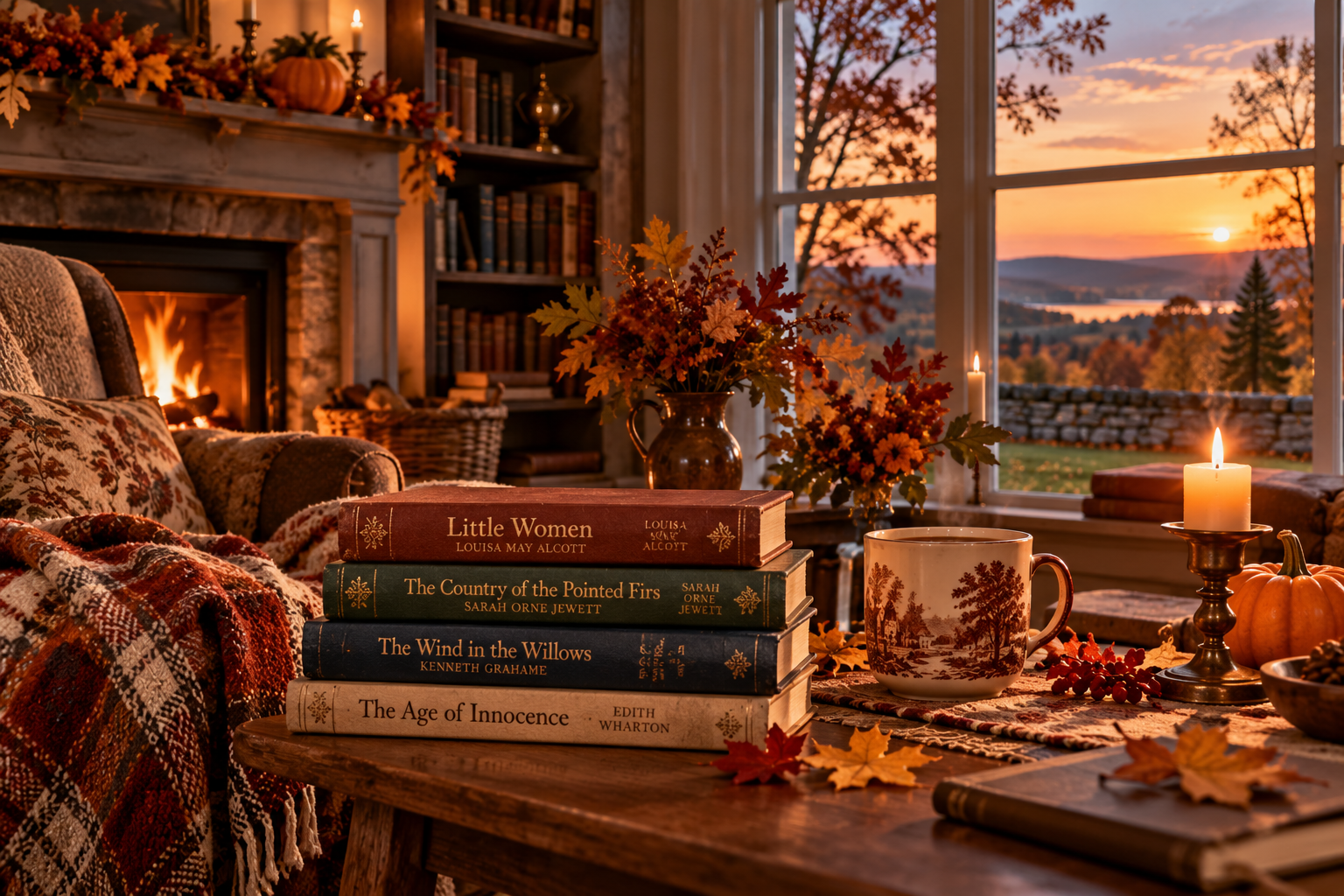
Books in this article
- Little Women — Louisa May Alcott
- The Country of the Pointed Firs — Sarah Orne Jewett
- The Wind in the Willows — Kenneth Grahame
- The Age of Innocence — Edith Wharton
These are not all Thanksgiving books in the literal sense. What connects them for me is the feeling I want from that weekend: home, familiarity, reflection, and a little distance from the noise of ordinary life.
Affiliate disclosure: This post contains Amazon affiliate links. If you make a purchase through one of these links, I may earn a small commission at no additional cost to you.
1. Little Women — Louisa May Alcott
If I were choosing only one classic for Thanksgiving weekend, I think it would have to be Little Women.
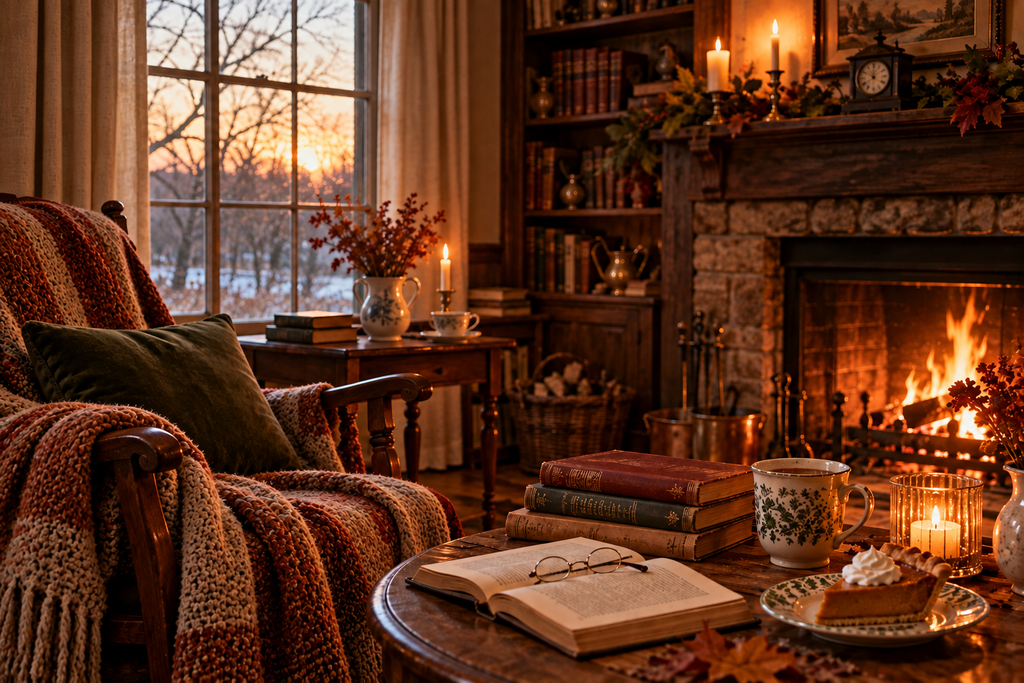
There are books that feel tied to a particular season even when the story itself moves through many of them, and this is one of those books for me. I associate it with colder weather, domestic rooms, old-fashioned routines, sisters gathered together, food being prepared, letters being read, fires burning, and all the little details that make a house feel inhabited rather than simply beautiful.
Perhaps that is why it works so well for Thanksgiving.
At its heart, Little Women is so much about family life—the warmth of it, but also the irritation, sacrifice, disagreements, disappointments and constant adjustments that come with loving people closely.
The March household is not perfect.
That is part of its charm.
People lose patience. They want things they cannot have. They misunderstand one another. They feel jealous, disappointed and restless. Yet there is always a sense that the family itself matters more than whichever small difficulty has taken over the day.
That feels particularly appropriate after Thanksgiving dinner, when everyone has eaten too much and the house has become pleasantly untidy.
I can imagine reading this one late in the afternoon, when nobody quite wants another meal yet but somebody has already started talking about leftovers.
There is also something deeply comforting about the physical world of the book.
The sewing, reading, cooking, visiting and walking.
The sense that ordinary life is made meaningful partly because people pay attention to it.
Modern life often pushes us toward whatever is next. Little Women seems to keep pulling us back toward what is already in the room.
A sister.
A mother.
A book.
A fire.
A difficult day that eventually ends.
It is sentimental in places, certainly, but I don’t mind sentiment when it is sincere.
Sometimes a cold November weekend is exactly the right time for a book that still believes home can be one of the most important places in a person’s life.
2. The Country of the Pointed Firs — Sarah Orne Jewett
This is perhaps the quietest book on the list.
And that is exactly why I would want it over Thanksgiving weekend.
Sarah Orne Jewett’s The Country of the Pointed Firs takes us into a small coastal community in Maine, and much of its beauty comes from observation rather than dramatic events.
People visit.
People remember.
Stories are told.
The landscape slowly becomes part of the experience.
It is the kind of book that asks you to notice rather than rush.
That makes it wonderfully suited to a weekend when I would rather not feel rushed either.
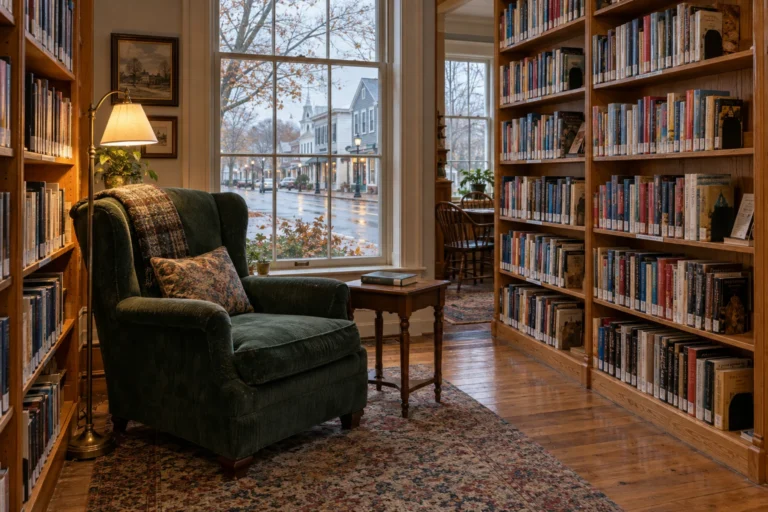
There is something especially appealing about New England at this time of year. The bright autumn colour has mostly faded by Thanksgiving. What remains is quieter: gray water, evergreen trees, cold roads, weathered houses, and that unmistakable feeling that winter is close.
I love landscapes once they have stopped trying to impress us.
Late autumn can be beautiful precisely because so much has already fallen away.
Jewett’s world has that same restrained quality.
The people matter because they have lived in one place long enough to become part of it.
They know each other’s histories.
They remember who used to live in which house.
They understand the weather and the sea and the small distances between one person’s life and another’s.
After writing about what I love about Thanksgiving, I keep thinking about the importance of simply sitting down together and noticing the life already around us.
This book feels connected to that same idea.
Nothing has to happen quickly to matter.
Sometimes a conversation can be enough.
A walk can be enough.
An afternoon in someone else’s kitchen can become something worth remembering years later.
That may sound almost too quiet for some readers.
For me, it sounds perfect.
Find The Country of the Pointed Firs on Amazon
3. The Wind in the Willows — Kenneth Grahame
This may seem like the unusual choice on the list, but I think The Wind in the Willows belongs here.
There is a particular kind of comfort in this book that has very little to do with age.
Yes, it is often described as a children’s classic. But the older I get, the more I understand why adults continue returning to it.
So much of the book is really about the pleasures of home and friendship.
Meals.
Journeys.
Returning after being away.
Warm rooms after cold weather.
Knowing where you belong.
And of course, there is one idea running beneath everything that feels particularly suitable for Thanksgiving weekend:
Sometimes the best part of leaving home is discovering how good it feels to come back.
I think that is something holidays remind us of.
People travel for Thanksgiving. They drive for hours, fly across the country, pack bags, arrive tired, eat together, sleep somewhere unfamiliar and then eventually make the journey home again.
And home somehow looks different when you return.
Grahame understands that feeling beautifully.
There are passages in The Wind in the Willows where domestic comfort almost becomes an adventure of its own. Food tastes better because someone has been outside in the cold. A room feels warmer because the road has been long. Familiar things become precious because you have been away from them.
That is very Quiet Hearth to me.
We often think comfort means avoiding discomfort entirely.
But sometimes comfort is strongest because you have just come in from somewhere cold.
A warm drink matters more after a walk.
A fire matters more when your hands are chilled.
Home matters more after the road.
I would read this one in the evening.
Perhaps after a walk when the November air has become colder than expected, when daylight is already disappearing and the house suddenly seems particularly inviting.
It is not a Thanksgiving story.
But it understands why coming home matters.
Find The Wind in the Willows on Amazon
4. The Age of Innocence — Edith Wharton
For the final book, I would choose something slightly different.
The Age of Innocence is not cozy in the same way as the first three.
Its rooms may be beautiful, its dinners elaborate and its society carefully ordered, but underneath all of that elegance there is tension.
People want things they cannot say aloud.
They follow rules they may not believe in.
They make choices partly because everyone around them expects those choices to be made.
And perhaps that makes it especially interesting to read during a holiday built around tradition.
Thanksgiving itself is full of traditions.
Some we love.
Some we inherit.
Some we repeat because they genuinely mean something to us.
And some we probably continue simply because that is what has always been done.
Wharton’s world takes that idea much further.
The rituals of society are so powerful that they can shape an entire life.
A dinner invitation means something.
The arrangement of a room means something.
Who visits whom means something.
Who does not visit may mean even more.
I find that world fascinating.
It is beautiful from the outside and often suffocating underneath.
And perhaps that is one reason The Age of Innocence works so well as late-autumn reading.
There is a coldness beneath the elegance.
A sense of things being preserved long after they have stopped fitting the people trapped inside them.
Yet it is also a deeply emotional book.
Not loudly emotional.
Wharton rarely needs to shout.
The sadness is often contained inside things left unsaid.
A gesture.
A decision.
A moment when a different life seems possible and then quietly disappears.
That restraint makes the book linger.
I think Thanksgiving weekend can hold a little of that reflective mood too.
After the food and noise and conversation, there is often a quieter evening when everyone begins thinking about the year that has almost passed.
Christmas is close.
Another year is close behind it.
And suddenly November feels less like a season and more like a doorway.
Find The Age of Innocence on Amazon
If you already enjoy classic novels for long November evenings, this would fit beautifully into that same late-autumn mood while giving the weekend something slightly sharper than pure comfort.
Why I Would Keep the List Short
There is a reason I chose four books rather than ten.
Thanksgiving weekend does not feel like a time when I want an enormous reading challenge.
I don’t need a stack of books beside me making me feel as though I have another task to complete.
Four is already more than anyone is likely to finish over a single weekend.
That isn’t really the point.
The list is more about choosing the kind of world I would like to spend a few hours inside.
Perhaps I would only read one.
Perhaps I would begin one on Thanksgiving evening and still be reading it well into December.
That seems much nicer than trying to race through a list just to say I finished it.
Reading should not become another way of being busy.
Especially not during a holiday weekend.
The Perfect Thanksgiving Reading Afternoon
If I could choose the afternoon, it would probably begin after lunch on the day following Thanksgiving.
The house would be quieter.
There would still be leftovers, which means nobody needs to think seriously about cooking.
Outside, it would be cold enough that going anywhere felt unnecessary.
The sky might be gray.
I would make coffee or tea, find somewhere comfortable, and tell myself I was going to read for twenty minutes.
Then ideally lose track of time.
That is the best kind of reading afternoon.
No plan.
No target.
No attempt to finish a certain number of pages.
Just the gradual disappearance of the room around you.
Perhaps that is one of the reasons classics work so well in late autumn.
They require a little patience.
Their worlds often move more slowly than ours.
A visit may occupy an entire chapter.
A letter may change everything.
People have time to walk somewhere and think before they arrive.
For a while, we have to move at their speed.
And I like that.
One Weekend Between Autumn and Christmas
Thanksgiving weekend also sits in a strange little space between seasons.
Autumn has almost ended.
Christmas is waiting immediately ahead.
By Monday, everything will feel different.
The music changes.
The decorations appear.
The calendar suddenly seems much busier.
That is why I like the idea of keeping part of Thanksgiving weekend deliberately quiet.
Before Christmas begins properly, there is still time for one more late-autumn afternoon with a book.
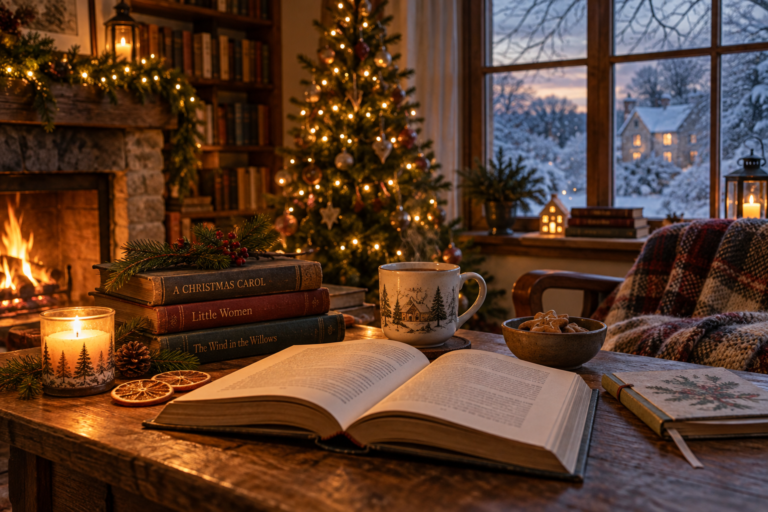
Soon I will want stories filled with snow, Christmas houses, candlelight, winter journeys and all the particular comforts of December.
But not quite yet.
There are still the quiet weeks before Christmas ahead.
For one final November weekend, I would rather stay with bare trees, cold roads, old houses and books that make the world feel a little slower.
If I Had to Choose Just One
And if someone told me I could only take one of these books into Thanksgiving weekend?
I would probably choose Little Women.
Perhaps that answer is predictable.
I don’t mind.
There are times when originality matters, and there are times when you simply want the book that feels right.
Thanksgiving is about home more than anything else for me.
And Little Women understands home in all its imperfect forms.
Not simply as a beautiful room.
Not as an address.
But as people who know you well enough to annoy you, forgive you, worry about you, feed you and leave an empty space when they are gone.
That feels appropriate for a holiday centred around gathering together.
So I would take the book, find a quiet chair after dinner, and read until the room around me became darker than I realised.
Someone would eventually switch on a lamp.
There would still be pie somewhere.
Christmas could wait until tomorrow.
And for one more evening, it would still be November.