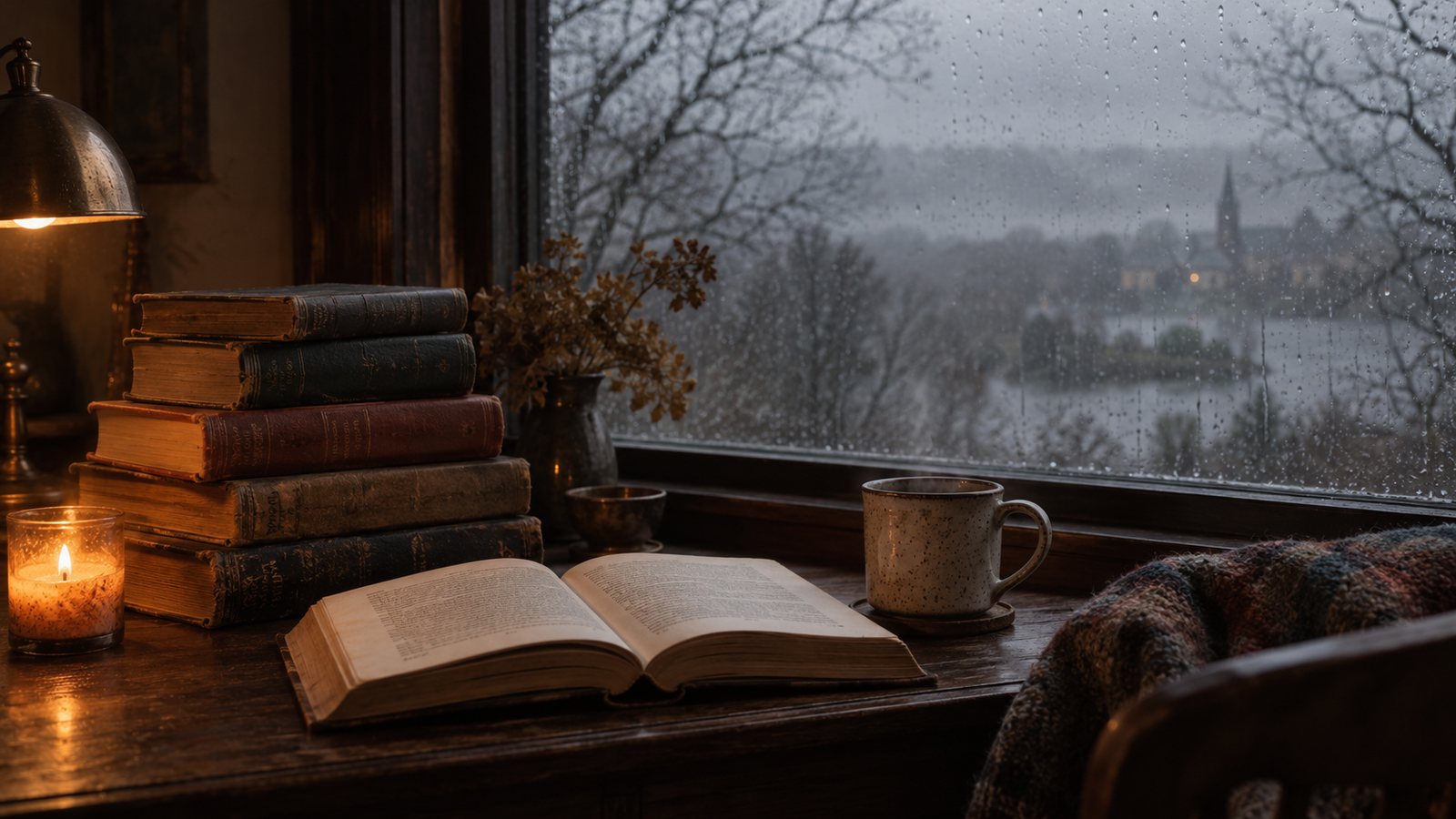
7 Dark and Melancholy Classics for Cold, Gray Days
There are books I want when the sun is shining, the windows are open, and the day feels too full of possibility to spend indoors. And then there are books for completely different days.
Days when the sky seems to have forgotten color. When the light never quite improves after morning, the trees are bare or dripping with rain, and staying inside with a book feels less like avoiding the weather and more like agreeing with it.
Those are the days when I find myself reaching for dark and melancholy classics.
Not necessarily horror, and not always Gothic in the obvious sense. What I want is something quieter and heavier: lonely houses, bleak landscapes, people carrying things they cannot quite escape, old social rules closing around them, and stories in which the weather somehow seems to understand the characters better than anyone else does.
These are not always comforting books in the usual meaning of the word. Some of them are deeply sad. Some are unsettling. Some leave you frustrated with the choices people make or with the world they have been forced to live inside.
And yet there is something strangely comforting about reading them on a cold, gray day.
Perhaps it is simply that the atmosphere outside and the atmosphere on the page begin to belong together.
Here are seven books I would choose for exactly that kind of day.
1. Tess of the d’Urbervilles — Thomas Hardy
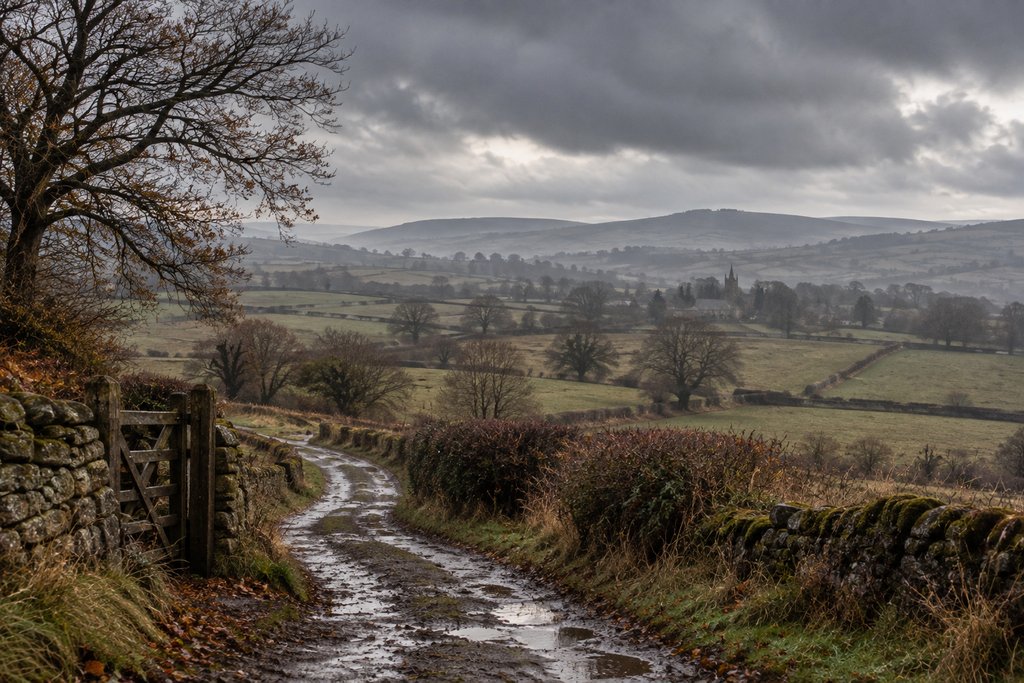
Few writers make the landscape feel as emotionally important as Thomas Hardy does.
In Tess of the d’Urbervilles, the countryside is beautiful, but that beauty never feels simple. Fields, lanes, farms, changing seasons, rain, cold, and darkness seem to move alongside Tess rather than merely surrounding her.
That is one of the reasons this book stays with me.
Tess herself is caught in a world where the consequences of other people’s choices continually become hers to carry. There is a terrible unfairness running through the novel, and Hardy never allows us to forget how easily social judgment can become more powerful than compassion.
It is not a light book. There are moments when you want to reach into the story and change the direction of someone’s life before it is too late, but that is also what gives the novel its emotional weight.
Tess does not feel like a character simply moving through a carefully constructed plot. She feels like someone being carried through seasons and circumstances that are slowly narrowing around her.
I think this is the kind of novel that becomes even more powerful when you read it in winter or late autumn. A warm room almost creates a boundary between you and the world Hardy is describing. Outside the window there might be rain, bare branches, or fading afternoon light, while inside you are following Tess through another landscape that somehow feels just as cold.
Of all the books here, this may be the one that best represents what I mean by melancholy reading.
It is beautiful, painful, and almost impossible to separate from the weather surrounding it.
2. The Return of the Native — Thomas Hardy
I know including two Hardy novels may seem like a lot, but I cannot really imagine a list about bleak landscapes and gray-weather reading without giving him the space.
The Return of the Native feels different from Tess of the d’Urbervilles, even though the same sense of inevitability hangs over it.
Here, Egdon Heath almost becomes a character of its own.
The landscape is ancient, dark, difficult, and indifferent to whatever hopes the people living around it may have. It feels as though it existed long before them and will remain long after all their disappointments have been forgotten.
That atmosphere is what draws me into the book.
There are characters who want to leave, characters who want to return, and characters who imagine another life somewhere beyond the world immediately around them. Yet the heath is always there, holding everyone within the same physical and emotional space.
Hardy is especially good at writing about the distance between the life someone imagines and the life that actually becomes theirs.
That gap can be painful to read.
But on a dark afternoon, with the light beginning to disappear far earlier than you want it to, there is something almost hypnotic about entering a world where the landscape feels just as restless and dissatisfied as the people inside it.
If Tess feels tragic, The Return of the Native feels brooding.
It is a book for evenings when you want the landscape to take over the room.
3. Villette — Charlotte Brontë
Villette has a loneliness to it that feels very different from the sweeping tragedy of Hardy.
Lucy Snowe is quieter, more guarded, and more difficult to know completely. Because of that, reading the novel can sometimes feel like sitting beside someone who is telling you only part of what she feels.
I think that distance is part of what makes the book so compelling.
Lucy moves away from everything familiar and builds a life in a foreign city, but the idea of starting again never becomes the simple transformation it might be in another kind of novel.
Loneliness follows her.
Uncertainty follows her.
And even when people surround her, there is often a sense that she remains slightly apart from them.
Charlotte Brontë creates an atmosphere that can feel surprisingly intimate in that respect. Lucy’s inner world is complicated and private, and the novel does not rush to make everything comfortable for the reader.
There are also moments of strange unease running through the story, enough to give the book a faintly Gothic edge without turning it into the kind of Gothic novel I would choose purely for atmosphere.
What stays with me most, though, is the emotional weather of the book.
It feels subdued. Cold in places. Restless in others.
It is the sort of novel I can imagine reading while rain slowly darkens the windows in the middle of the afternoon.
Not because it will cheer the day up.
Because it somehow understands it.
4. The Woman in White — Wilkie Collins
This is probably the most immediately mysterious book on the list.
The Woman in White begins with one of those encounters that makes you feel, almost immediately, that something is wrong.
A lonely road. A strange woman dressed entirely in white. A meeting that should perhaps have been forgotten but instead opens the door to secrets, identities, inheritance, manipulation, and one of the great Victorian mysteries.
What I love about this book for cold-weather reading is the feeling that the mystery keeps pulling you farther inside.
There are country houses, private conversations, documents, hidden motives, and people who never seem quite as straightforward as they first appear.
And because the story is told through different voices and written accounts, it often feels as though you are assembling the truth yourself.
That makes it wonderfully absorbing.
On a gray Sunday when the weather has removed any temptation to go outside, I want a book that gives me a reason to stay exactly where I am.
The Woman in White does that.
It has enough shadow and unease to suit the season, but it is also simply an excellent story. There is always another detail to notice, another suspicion, another piece of the puzzle.
This one is less about sinking into sadness and more about disappearing into atmosphere.
And sometimes that is exactly what I want from a dark day.
5. The Turn of the Screw — Henry James
Some books frighten you by showing you exactly what is happening.
The Turn of the Screw is unsettling because it refuses to make things so easy.
A governess arrives at an isolated country house to care for two children. Then she begins seeing figures.
From there, the story becomes increasingly uncertain.
What is real? What happened before her arrival? What do the children understand? And how much should we trust the person telling us the story?
That uncertainty is what makes the book work.
The house and grounds feel quiet enough that every strange detail becomes more noticeable. A figure standing somewhere it should not be. A face where you do not expect one. A silence that suddenly feels too complete.
It is not the kind of book I would choose for a bright summer afternoon.
I want darkness outside for this one.
I want a lamp on.
I want the window to have turned into a black reflection of the room.
There is something about reading an ambiguous ghost story under those conditions that makes the imagination far more cooperative than it ought to be.
And perhaps that is why The Turn of the Screw has lasted so well.
The story does not simply tell you what to fear.
It leaves enough empty space for you to bring some of the fear yourself.
6. Ethan Frome — Edith Wharton
If I had to choose the coldest book on this list, it might be Ethan Frome.
Not only emotionally.
Physically.
Snow, isolation, frozen roads, difficult winters, and the feeling of being trapped in a life that has grown smaller than the person living it are everywhere in this short novel.
Ethan lives in a world that seems almost completely sealed off from warmth and possibility.
His circumstances are narrow. His marriage is unhappy. And when something appears that might offer a different future, the possibility itself becomes almost painful because of how unlikely escape feels.
The winter landscape makes everything stronger.
The snow is not decoration. The cold is not simply there to create a beautiful setting.
It becomes part of the emotional imprisonment of the story.
That is why this is such a perfect book for one of those days when winter seems to have erased the edges of the world outside.
There is something stark about reading Ethan Frome while knowing you can put the book down, make something hot to drink, and return to a warm room.
The contrast makes the novel feel even colder.
It is a short book, but it leaves a long shadow behind it.
7. The Woman in Black — Susan Hill
There are certain settings that seem made for ghost stories.
An isolated house.
Marshland.
Mist.
A road that can disappear beneath the tide.
A place cut off from the rest of the world at exactly the moment you would most want to leave it.
The Woman in Black understands that completely.
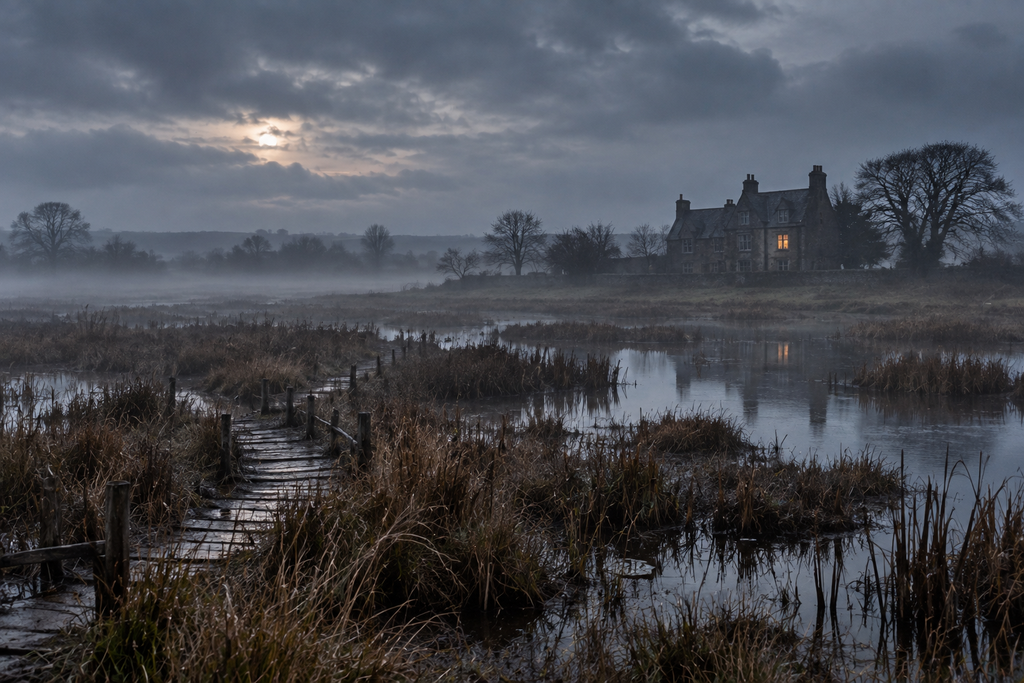
From the moment Arthur Kipps begins dealing with Eel Marsh House, there is a sense that the landscape itself is warning him away.
The isolation is what makes the story work so well for me.
There are no crowded city streets to break the tension and no easy escape into noise or ordinary life.
Instead, there is the house, the marshes, the weather, and the growing certainty that something terrible is connected to the place.
Susan Hill’s style also suits the story beautifully because she does not need constant shocks to create fear.
Much of the atmosphere comes from waiting.
From listening.
From wondering what might be just outside the room.
This is the book on the list I would save for the darkest evening.
The kind when the weather is bad enough that the house already feels a little more isolated than usual.
Then I would make tea, turn on one lamp, and immediately question why I thought reading a ghost story alone was such a good idea.
Which, of course, is exactly the point.
Why Melancholy Books Can Still Feel Comforting
I sometimes wonder why books filled with loneliness, difficult lives, bleak weather, ghosts, disappointment, and tragedy can feel so comforting.
It sounds contradictory.
Comfort should probably mean something cheerful: a happy ending, a warm house, people finding exactly what they need.
And I love those stories too.
But comfort can also come from atmosphere.
Sometimes the best book is simply one that matches the mood of the day instead of trying to fight it.
When rain has been falling since morning, I do not always want to read about beaches and endless sunshine.
Sometimes I want Egdon Heath.
Sometimes I want the snow around Ethan Frome.
Sometimes I want to walk toward a lonely Victorian house knowing perfectly well that nothing good is waiting inside.
There is a strange pleasure in allowing a story to make the world darker for a few hours when you know you can close the book whenever you choose.
Dark and Melancholy Classics Belong to a Different Kind of Reading Day
I think this is what separates these books from the Gothic and dark academia novels I reach for during rainy autumn weather.
There is some overlap, of course. Old houses appear. Secrets appear. Ghosts occasionally appear.
But the feeling I am looking for here is different.
It is less about the aesthetic pleasure of Gothic and dark academia classics for a rainy autumn day and more about lives shaped by isolation, disappointment, landscape, memory, social expectations, and the things people cannot easily change.
These books ask you to sit with uncomfortable feelings for a while.
They rarely rush to relieve them.
And perhaps that is exactly why they work so well when the world outside has already become quiet and gray.
The Pleasure of Returning to an Older World
Another reason I love reading classics in colder weather is how completely they remove me from the present.
Phones disappear. Notifications disappear. Modern schedules disappear.
Instead there are letters, train journeys, candlelit rooms, long walks, fires, drawing rooms, muddy lanes, and distances that cannot be crossed in twenty minutes.
Life is not necessarily easier.
Usually it is not.
But it moves differently.
That change of rhythm matters.
It is related to the same reason I return to certain fictional worlds again and again. I like the feeling of opening a book and allowing the ordinary world to become quieter for a while.
A classic novel does not need dragons or magic to create another world.
Sometimes a Victorian house, a lonely moor, or a snow-covered New England village is enough.
The Books I Would Keep Closest on the Grayest Days
If I were choosing purely by mood, I think I would reach for Hardy when I wanted landscape and melancholy, Villette when I wanted loneliness and introspection, and The Woman in White when I wanted the gray day to disappear into a mystery.
The Turn of the Screw and The Woman in Black belong to nights when I want the house to feel slightly less comfortable than it did before I started reading.
And Ethan Frome is probably the one I would choose when winter itself feels like part of the story outside my window.
None of these books are cheerful recommendations.
That is not what this list is trying to be.
They are books for days when something darker feels more appropriate.
Days when the sky remains gray from morning until evening. When the kettle seems to be boiling more often than usual. When the lamp comes on before dinner.
When reading something melancholy does not make the day feel worse.
Somehow, it makes everything fit.
And sometimes that is its own kind of comfort.
What is the book you reach for when the weather turns cold, dark, and gray?